Showing posts with label Rwanda. Show all posts

Friday, November 14, 2014

My Sandlot


Growing up, I always envied the boys from The Sandlot. I always knew I would love the kind of simple lifestyle that revolves around a community of friends and passion for a sport. Of course, I played a lot of sports growing up, but it was always in the convoluted environment of leagues, teams, organizations, rivalries, playoffs bureaucracy and multiple ranks of coaches. It was rarely in that carefree arena where the only things that matter are that your friends showed up and the ball lasted until the end of the day.

After living in Rwanda for about nine months, I realized my life was starting to parallel that of Smalls, from the Sandlot. I was the new kid in town. I was shy and didn’t really have many friends. I eventually found some people to play ball with. After a while, I learned all their nicknames, was welcomed into their community, and played with them almost every single day. Eventually they invited me to their tree house for a sleep over, and I learned about the scary dog that lived next door. The scary dog would later steal my step dad’s basketball, which was autographed by Wilt Chamberlain. Manasse, the best player, jumped over the fence and got my ball back. The owner of the dog turned out to be James Earl Jones, and Manasse went on to be a professional basketball player.

Well, some of that really happened.

Regardless, the most important part of my day was lacing up my decaying sneakers and heading to the court where I could count on a group of guys ready to play ball.


***

Manasse really was the Benny of our basketball community. He was the most gifted athlete, had the strongest passion for basketball and was just a really nice guy. Everybody liked him. Sometimes he coached a group of girls, which I really respected. The girls in the community rarely got to play. I would try to get the boys, especially students from my school to share the ball with them. Manasse, however, was the only one I ever saw put any effort in supporting girls basketball.

Manasse is an unstoppable force.

He can't be stopped.

***
It took a while to learn everyone’s nicknames, and I wasn’t even sure where most of them came from. There was Pastor (Pasteri), who I assumed had earned the moniker for his staunch protestant beliefs…until I bought him a beer while watching the world cup. Fizzo might have gotten his name from his slight stature, since sometimes it was spelled or pronounced “fils”, the French word for son. Sometimes Epa tried to give himself the nickname “Reblon”, a mispronunciation of Lebron. Luckily for him it didn’t stick. I was never sure if the lanky kid referred to as Hamza was Muslim, or somehow he had just acquired the Arabic word for 5 as a nickname. My snaggle-toothed friend who wore a jersey that had somehow made its way from Coeur d’Alene’s alternative high school introduced himself as Gavin. Everyone called him something that sounded like “Jivva”.
At some point, Moise started going by Moses, the English version of the French name. And my nickname? Well, it might as well have been Joel, since most people couldn’t comprehend the name “Joey.” A few people caught on, but in general, I was Joel. 

Epa has a sick jump shot.

Pastor takes his signature jump shot from the free throw line.

***
The basketballs we played with were perpetually over-inflated. I always lectured the guys not to over-inflate the balls, but they never listened. The lifespan of the balls was short. Sometimes they would develop a bubble. One time, I threw the ball from under the hoop and it caught the bottom corner of the backboard and exploded. It was the end of our game for the day.

***

Basketball with these guys was rough. I regularly walked home limping, bleeding or smarting from a fresh lump on my head. I sprained my ankle once, took a few game-ending nut shots and once went flying head first into a pole at full speed after getting tripped on a fast break. That last one terrified me as it was the kind of injury that could have easily been life changing. Usually when I went down from slamming into poles or twisting an ankle, my teammates would find the damaged area and start massaging it intensely. I usually had to yell through clenched teeth to get the hell away from me. They didn’t understand why I didn’t want their help. But maybe there was something to their methods. I can’t remember a single time when someone seemed even remotely in pain from the constant jostling and violent fouling that went on under the hoop. The day after I sprained my ankle, Baya visited me with some imitation tiger balm and leaves from a citrus tree. He said he would help my swollen ankle. I was more curious than optimistic. He rubbed the balm over my ankle while boiled the leaves. Then he took the leaves packed them in a hot wad and started pressing them into my ankle with his palms. I winced and squealed as he kneaded the leaves into my ankle. It was incredibly painful, but I appreciated his thoughtfulness. I have no idea if this helped, but within a few days I was playing again.

Taking it inside is a dangerous activity in Rwanda.

***

While I loved the fact that everyone was friends and played together peacefully, sometimes I felt like there wasn’t enough trash-talking, showboating or overall competitiveness for street ball. I, on the other hand, got out of control on a regular basis. I am a pretty good sport with a mild temperament. I don’t even think I have felt a competitive emotion well up in me since I was in high school. But getting back on the basketball court brought out a side in me I forgot existed. I lashed out at people for calling fouls, I cursed and smacked the court when I missed easy shots and I threw the occasional cheap shot at people who had recently committed flagrant fouls. What made my lack of control worse was that Rwandan culture dictates strict management of emotions. Losing your cool is, well, not cool. It makes everyone uncomfortable, and people generally respond by laughing awkwardly. When things got intense on the court, I turned into Charles Barkley with a twist of Dennis Rodman. My most shameful moment came when I was blatantly pushed out of bounds on a fast break. Our acting referee didn’t blow his whistle. The aggressor, who is really one of the nicest, most genuine guys in town, denied blatantly pushing me out of bounds when I protested. My emotions got away from me, and I shoved him in the chest. He looked as surprised as I felt as he stepped to me. All eyes were on us now, and I suddenly came to my senses. I smiled, tried to act like it had been a joke, and went back on the court. I apologized after the game for taking it too far.

The positive energy was also a bit lacking. Whenever a game came down to the wire and I was at the free-throw line, I would insist that my teammates and the kids watching cheer for me. Sometimes I felt like I was channeling Kenny Powers and his quest for baseball stardom in Mexico.

My biggest fan.

Manasse shoots a free throw.

***

The only player who ever showboated was a young up and comer named Mucoma. At first he would only get a spot when we were short on players. He was fundamentally weak and clumsy. He was rough, out of control and missed too many easy shots. He didn’t know how to pass. However, he played harder and with more heart than almost anyone else on the court. Suddenly, he became a player, slowly scoring more baskets. It took a while for him to be seen as a real threat and was generally left unguarded. The more he scored, the more confident he became. He started celebrating after nailing 8-footers, running around with his arms extended, pumping up the imaginary crowd and yelling, “THE CHAMPION!” I found it obnoxious, and eventually made it my duty to knock this guy back on his place. I would cover him tightly and make sure he would go scoreless. This frustrated him to no end, and he would actually get mad at me for not guarding him. I enjoyed matching up with him because no matter how physically I played against him, he would always be rougher than me. He was one of those guys that didn’t know his own strength and couldn’t control his body. The blows he delivered when contesting a drive to the basket were lethal. I was often on the ground when matched up with him. My dislike for Mucoma grew, over a long time, into a reserved respect. I appreciated that after a few games, he was the only one still playing at 100%. I rarely let my admiration show, though.  I just continued to battle him for every rebound and contest every one of his drives to the hoop with the well-intentioned maliciousness of an older brother. As he got better, I think I was the only person who noticed that Mucoma was often the highest scorer on his team (when I wasn’t guarding him) and was the deciding factor in a lot of games.

Mucoma takes it to the hole.

Not in Mucoma's house.

***

The hoops were a little under 10-feet tall, so it wasn’t surprising that I saw a couple of guys learn to dunk while I was there. Pastor and Moise were the first to dunk during games. When we were shooting around, Mucoma always tried to dunk. For a while he would either get rejected by the rim, or would turn his attempt into an awkward finger roll at the last second. Little by little, however, he got better. Eventually he could get the ball over the rim, but it would either slam off the backboard or the back of the rim. Then, I remember when it happened. He told everyone to clear the lane. He ran with in a slight arc toward the hoop, the ball clasped between his hands. He leapt up, put the ball over the edge and grabbed the rim. The ball clanged and he released the rim. The rim snapped up and shot the ball soaring fifteen feet in the air. It came straight down and went right through the center of the naked hoop. Mucoma accepted this as a successful dunk and ran around court with his arms extended, and cheering for himself. I reluctantly applauded.

Mucoma knows how to dunk.
Moise also knows how to dunk.
***

Most villages in Rwanda don’t have a functional basketball court. We were lucky, however, that the cement factory in the community not only owned one, but maintained it and kept it, somewhat, open to the public. I was excited when I returned from Christmas break to find the court re-painted, the fallen rim replaced and both backboard refurbished. We could finally resume our full-court games.

Manasse with a reverse layup.

The most exciting moment, however, was the night they turned the lights on. Sure, I had always noticed that the court had four stadium lights, but never even considered that they might work. Then, one night, they just came on. It was like 4th of July in The Sandlot. We played an hour past sunset that night. After that we often got extra time on the court after dark and even got to play an organized game at night.

***

That game, between the secondary students in the community and the adults was a highlight of my Rwandan basketball career. I didn’t play well, and the game wasn’t close, but the atmosphere of playing under the lights, with a small crowd watching took me back to the days of high school sports.


The two teams, as labeled on the scoreboard etched on the cement with a red stone, were “Students” vs “Old Man”. I was on the team of Old Man, and I thought we were going to get crushed. However, what we lacked in bottomless energy, speed and fundamental skills, we made up for in teamwork. We won with a score of something like 142-84. We only played three quarters, as the security guards kicked us out at 8 PM.

***

I sweat a lot in normal life. I sweat even more when playing basketball. I sweat buckets when playing full court basketball in a swelteringly humid climate. I was constantly battling to keep hydrated. However, it didn’t matter how much water I brought to the court, it was never enough. I was the only person who ever brought water (hydration isn’t a big thing in Rwandan culture). Everyone else was always thirsty, and when things enter a public space in Rwanda, they tend to become public property. So I had to share my water with everyone as soon as I took my bottle out of my bag. This wasn’t a problem when there was a tap by the court. For some reason, though, the tap was turned off, and the nearest water source was a few minutes away. Sometimes boys were sent to refill my bottles, but not always. After a long game, one day, I went looking for my water bottle. We had sent a boy to refill my reused disposable water bottle, but it was nowhere to be found. I was furious. I never bought bottled water, so I clung tightly to these bottles. “Where is my bottle?!” I yelled. One of the players shrugged and said one of the boys probably took it. They are always asking for my bottles, but only once had one of them actually stolen it. I slammed the ball onto the ground in anger. The ball did what overly inflated balls do: it bounced back at me with shocking force and jammed two of my fingers. My right middle finger would remain puffy and sore for a couple of months. Just as I realized I was embarrassing myself again, I saw a six-year-old boy in ripped shorts and a filthy shirt waddling toward me with an arm extended, holding my full water bottle.

The next day Hamza brought me a box with about 12 empty water bottles. It might have been one of the most thoughtful things anyone had done for me in Rwanda. It was also kind of awkward.


***

My neighbor Baya is one of my best friends in Rwanda. He comes to the court sometimes, but usually isn’t good enough to get a spot on the court. His sport is soccer. Usually only the best players get to play, and I was never one to decide who got a spot. One day, Baya was playing when I showed up and they immediately gave me his spot. I refused and said he could continue. I would wait until someone was tired. Baya, knowing his place in the social order, also told me to take his spot. I refused again. The older players said that Baya covldn’t play because he was wearing flip-flops. That had never been a problem for some of the more skilled players, but if that was their reason, I would respect that. So I took off my shoes, to everyone’s wide-eyed amazement, and handed them to Baya. I was trying to make a point, but I could tell I was putting Baya in an awkward position. I insisted he put them on and keep playing. He continued for a few plays, but then came out, telling me to replace him. I was done fighting this, but I still wasn’t going to take my shoes back. Most people that played regularly had shoes, but occasionally there was someone in flip-flops or barefoot. I wanted to make the point that not only could I play without shoes, but that they should be more inclusive with who they let play, regardless of footwear. I wondered if it was worth it though. I don’t think it changed anyone’s mind, and I think I shamed Baya by trying to come to his rescue.

***


While a lot of my time in Rwanda was bland and forgettable, I will always miss the Cimerwa basketball court. It was the strongest community I had and I don’t think I would have lasted long without it. It was also a vital release valve for my pent up emotional energy that built up throughout the day. While I may have let my emotions get the better of me on the court, I imagine I would have had much more damaging incidents if I didn’t have basketball. 

The one time you will see me willingly pose for a group photo. From left: Epa, Manasse, Moise, Pastor, Mucoma, Joel. 

Tuesday, September 30, 2014

A Short Word On My Departure Rrom Rwanda


As I began to face the last six months of my Peace Corps service and contemplate what I had accomplished, I grew bitter and disappointed in myself. I felt that I had accomplished little in my school and community. My Kinyarwanda skills were lackluster, and my integration into my village, something Peace Corps puts an overwhelming emphasis on, was not what I had hoped it would be. I felt I had not grown much as a person, developed my teaching skills or gained a better understanding of the complexities of international development. Most of all, I felt guilty for not doing all I could have for my students and neighbors. I imagined that my final blog post would be titled something like “A Failed Service”.

I vowed to complete at least one of the several projects that were moving along at incredibly sluggish rates. At my final Peace Corps conference, about three months before departure, I began feeling miserable about the prospect of saying goodbye. I had bitter feelings toward the staff at my school, who had never followed through in assisting with a single project, Peace Corps in general, but most of all myself. I figured when the time came, I would say goodbyes to my students and selected friends and families, and slip out as silently and discreetly as possible.

Things started to look up, briefly, however, as I found an enthusiastic competent partner in the HR manager of Cimerwa, the cement factory that the village revolves around. He assured me that even with my short time, he would be able to quickly move the necessary mountains to help install the community library I had been working on for most of the year, as well as help with a couple of other, smaller projects that had been on the back burner. This news brought new life to my service and I was feeling more positive about my work than I had in I don’t know how long.

Days later, however, I made the decision to depart Rwanda as soon as possible. My wife was in need of my support. We had hoped to wait until the end of my service for me to move to France to be with her, however, my presence was needed and putting her first was the only option.

It was an incredibly difficult time for me, emotionally. I had about two days in my village to pack, say quick goodbyes and, most challenging, face my departure from Rwanda, where I had spent the last two years. My relationship with Rwanda was always very conflicted. It is no secret that it is not my favorite place in the world, but at the same time, I have spent more consecutive time in Rwanda than any other place in the past eight years. Leaving it suddenly was destined to be painful. I would later realize, however, there were band-aid like qualities of my departure, and getting it over quickly would more painful in the moment, but ultimately easier than something longer and drawn out.

It was a week spent on the verge of tears, where I was thankful for all the stress of paperwork, housekeeping and packing for distracting me from my emotions. Among all the other volunteers I spent time with in my last few days at the Peace Corps office, it was easy to pretend I wasn’t going anywhere. I went about my normal business, hanging out with them over Primus’s in the evenings, kicking around stories, complaining about our work and gossiping. This was more preferable than explaining why I was going, what I was going to do, and worst of all, goodbyes. I am not proud that I neglected to say goodbye to many people I had the chance to say goodbye to. I was taking the coward’s way out.


As I was completing some of my paperwork in the Peace Corps office, a staff member asked me how I felt about my service. I probably yammered on about my frustrations, my disappointment in myself, my uncertainties about my actual impact on my students. In reality, I have no idea at this point how I feel about my service. At this point, understanding those feelings is like trying to make sense of an impressionist painting from an inch away. Everything is an indiscernible blur. I think it will take a while to step back and make sense of the two years I spent in Rwanda.

Saturday, May 31, 2014

A Visit To Dan's House


My buddy Dan’s site and home is very different from mine. He shares a compound with a family, lives in a simpler home than I and his immediate surrounds feel much more rural and spread out than where I live. He also has an abundance of huge spiders all over the walls. They weren’t there the first time I visited, but the second time I visited, they were scurrying all over the walls. I kind of panicked and seriously considered staying up all night, sitting in the middle of the floor with a flashlight, shining it on the walls to keep an eye on the whereabouts of my worst enemies.

On my first visit, his site mate came over and we made Tom Kha (southeast Asian coconut soup) for dinner. We had a couple beers, and pretty late in the night it came up that there’s a river and a waterfall nearby his house. I was up for an impromptu adventure, so we decided to make the supposed thirty-minute walk through the forest. Dan had never been there in the dark, so unsurprisingly we were moderately lost after twenty minutes. Somehow we ended up incredibly high up on the steep hillside above the river. Trying to descend to the river was, at times, moderately harrowing. A bad step could have led to a seriously long tumble that would have at the least led to some broken bones. We made it, though, after a while of scrambling around the sparse forest.

And what can I say about it? The waterfall was modestly-sized, but beautiful, and most importantly, had a good pool below for swimming. We swam around for a while and sipped the beers we had brought along. Somehow the outside temperature and temperature of the river were perfectly comfortable. Most importantly, though, was the amount of solitude we had. It was a rare thing to be outdoors, and be completely free from the eyes of anyone. Rwanda is extremely densely populated, but we were about twenty minutes from the nearest house. That in itself is rare. Some of my most memorable moments in Rwanda are those in which I feel a strong sense of freedom. This was definitely one of those moments.

I returned to Dan’s months later for another little adventure. This time it was a little more intense. The plan was to walk and swim from the upper end of the river, down to the waterfall we had been to before. The river descended through a series of rapids and waterfalls before reaching the final pool. To get to the river, we went off a trail and bushwhacked briefly to stony area just above the river. When we got to a big flat boulder, Dan told me that this had been the spot where a European, who had lived in this village a few decades ago, would meet with the community. It was a seven-foot drop down to the riverbank, and we had to jump. Seven feet looks a lot higher from above and it was embarrassing how long it took us to jump down. We laughed at ourselves when we looked back up at the modest height we had been so nervous about.

The river was more of a shallow creek at this point. We took off our sandals and shirts and started wading downstream. There were a few rapids and slippery rocks, but for a while, everything was pretty calm. The first danger, to me, was the spiders. I noticed a few long web strands traversing the river, and delicately crept under them. A couple of the strands had huge, long spiders clinging to them. My skin crawled. Then I saw a tree that was hanging over the river that was crawling with these big spiders. Several strands crossed the river, with the spiders just chilling about three feet above the water, leaving me unable to cross. At this point I really thought I was going to have to give up. Spiders are my biggest weakness and I felt incredibly vulnerable. Dan fears bugs and insects, but claims spiders don’t bother him because they are restricted to their webs. He also said this would not be nearly the scariest part of the journey. He broke through the webs, which made me panic, since I couldn’t see where the spiders went when they fell. Surely they were in the river. I was in the river too. So, naturally, I was about to be crawling with homeless spiders. I waited a few moments, hoping the spiders would get a head start down the river in front of me and proceeded, keeping as far away from the tree as possible, ducking low, in case there were any more webs that Dan had missed. Dan was getting annoyed with my sudden shrieks. He wanted me to use my words. At one moment he was clambering over a rock, and shrieked again, as I saw he was about to put his head right into a floating spider. He glared at me and said, “Would you stop screaming?! What is wrong?” “Don’t move, there is a spider right next to your head,” I responded. He slowly turned and came face to face with the devil and shuddered in shock. He swatted it out of the air and continued on his way. Luckily that was our last spider incident of the day.

The river started to get bigger and at parts it became hard to proceed over slick rocks, rapids and little drop-offs. The most unique part came when the river basically fell into a hole in the rocks, making a little waterfall in a small cave. We had to get out of the river, and scramble down some rocks to get to the other side of the little cave. On the other side, the river was forced through a tiny channel between two rocks. We climbed into the incredibly strong current and clung to rocks as we inched up into the little cave. The whole river was falling about four feet through a hole in the roof of the cave. There were a couple of smooth rocks to sit on next to the falling water (waterfall). The force of the water coming down was tremendous and the sound was thunderous.

The current continued to get faster, the rapids rockier and the drops deeper, until we arrived at a full on waterfall. The drop was about thirty for forty eet. We obviously couldn’t just slide down, but Dan had been here once before and knew a way down. The way was not obvious by any means. We climbed out of the river, and had to scramble diagonally down a stone crevasse until we reached earth again. A short descent through steep greenery led us to the most intense part of the hike (except for the spiders, of course). We had descended almost halfway down the falls and were standing on an earthen ledge next to the rushing water. A six-foot drop below us was a stone ledge. Reaching it would be difficult. I suggested that just jumping to the ledge was feasible, but he insisted that it was too risky. The ledge was barely big enough for two people to stand on, and the chance of a bad landing, which would ensure a 15-foot rocky fall, was too great. He said the only solution was to slip down the near-vertical earth between us and the waterfall, then flip your body over and climb onto the ledge. I don’t know if my description is making any sense or if it sounds terrifying, but it was very terrifying. Dan had to psych himself up for a few minutes before even clambering down a body length. There was a vine coming out of the ground that I tested for strength. It seemed strong enough to rely on for support, so I handed it to him. He took another few minutes to psych himself for the couple of steps over to the ledge. Mind you, the physical act itself wasn’t incredibly challenging. The point is that the stakes were incredibly high. For a moment he would only be touching earth with one arm and one leg, as he swung his body over to the ledge, all while hovering about twenty-feet above jutting rocks and churning water. He had done it once before, but he was still incredibly on edge (get it?). With the help of the vine as an emergency support, he swung his body over and inched onto the stone ledge. He exhaled deeply and let out a big whoop. I don’t know if I was as scared as he appeared, but I thought I was holding it together better. I acted like it was no big deal as I slid my body down to where the first foothold was. It was at that moment that I realized how scary it really was. I still tried to not let on that I was nervous, probably because of my embarrassing behavior with all the spiders. I reached for the vine, and with just a tiny tug, it came free and fell into the chaos below. Dan realized the serious danger he had been in, putting most of his weight into the vine, which was apparently not as strong as well anchored as I had thought. When I finally made the steps over to the ledge, I had the added benefit of Dan being there, so he was able to grab me when I was halfway, and pull me over.

The hardest part was over, but we were still only halfway down the waterfall, and there was definitely no terrestrial route to the river below. We had to, nay, we got to jump. It was a big drop, but nothing that I haven’t done dozens of times in Idaho. I was only worried about the depth. The river above had never been more than four or five feet deep. I let Dan go first. When I entered the water, I was surprised to find that, although I descended incredibly deep, I never touched the bottom. I still remember that moment of my body hitting the deepest point, the murky water bubbly around me, coming to a slow halt, and rebounding towards the greenish surface where I could see the rippling light of the sun. When I reached the surface, I found myself in a pool that seemed calmly enveloped in green foliage. Before leaping from the ledge, I was still too jumpy (get it, again?) to appreciate the atmosphere. A sheer rock wall draped in vines rose thirty feet above us on one side, while the bushy vegetation was thick on the other. I felt very tucked away and secluded in this little pool, which is a good thing.

We continued. The natural part of this adventure was almost over. The human part of this adventure (which I should actually refer to as awkwardness, rather than adventure) was imminent. We arrived at the top of the last waterfall, the one that I mentioned on a previous visit, and bushwhacked around it.

I forgot to mention that this area is full of sacred prayer sites that people from all over Rwanda make pilgrimages to. There are a few big, flat stone surfaces and some caves where people come to pray. Dan knows most of the people in his village, but out here, most of the people he might run into are strangers.

As we tried to make our way around the waterfall, he noticed two old woman traversing a steep trail on a distant hillside. As we were very indecently dressed and behaving abnormally, splashing around in rivers and all, he didn’t want them to notice us. We stopped and hoped they wouldn’t see us. It might sound weird, but when you live in a small village like this, your reputation is important, and strange behavior and shirtlesness like ours will be looked on with suspicion or even disdain. Rwandans tend to be very observant, and within a couple of moments, they noticed us. They waved and we shouted a couple of greetings. I didn’t feel to awkward, since I was very far from my community, but I could tell it bothered Dan.

He told me that these women were probably visiting a nearby cave to pray in. He said he walked into one of these caves once and regretted it. A group of Rwandans were huddled together in the darkness, speaking in tongues. He said it was like the scene in “I Am Legend” where Will Smith stumbles into a dark building to find a group of vampires all crowded together in a corner.

The hike was done and as we crossed the river to head back, we found ourselves on one of the stone platforms. This was another popular prayer spot. We heard voices of people approaching. We tried to sneak around them, but inevitably ran into the group of pilgrims. They were clean and well dressed. We were half-naked, barefoot and dripping wet. We exchanged awkward greetings--theirs in halting English, ours in well-rehearsed Kinyarwanda--and passed each other without incident.

When we got back to the place where we had embarked on our journey, we realized we had to make the little jump off the rock to retrieve our effects. Then, after Dan made the anticlimactic leap, I realized that I didn’t have to go down, since he could throw me my things. Getting back up, for him, turned out to be stupidly complicated. He spent several minutes gracelessly clambering up through bushes and rocks, trying to find a route for the seven-foot ascent.

When we got back to his house, he realized he was out of water and we would have to take a walk to the spring to fetch more. Most Peace Corps volunteers, and many Rwandans, that don’t have running water pay someone to fetch it for them. I don’t have any criticism for this, but I do have mad respect for Dan for insisting on fetching his own water. It is clearly one of the many things he has done in his community to help him integrate and ingratiate himself with his community. I enjoyed the physical task of fetching water when I was in Mali, but am also glad that I didn’t have to face the decision of whether to do it for two years in Rwanda. I am one of the few volunteers that has running water in the home. I was originally disappointed by this because I wanted that experience of going to the water spout every day and mingling with all the women and children in line. I got used to it very quickly now, and have to admit that I am thankful constantly that I don’t have to run out and carry a 50 pound jug of water any time I run out of water. Dan’s fetching trip takes about 45 minutes, more when there is a line. Luckily, when we went, it was after dark, so there was nobody in line. On the way there, Dan had to pick up a new cork for his jerry can. And when I say cork, I mean one of those purple banana blossoms that hangs off the banana trees. This is a common cap replacement (NOBODY in Rwanda has the caps for their jerry cans). We had to go stumbling around a bunch of banana groves to find a blossom that was at the right size and stage of growth. It was a fun little excursion for me, since I had no idea how to find the right blossom or even that it was appropriate to nab one out of somebody else’s banana grove. 

I live in a Rwandan village, but it is incredibly different from Dan’s. My house and immediate surroundings do not feel “village” on the level that Dan’s site is. I am usually grateful for my community’s relative modernity, with a basketball court and well-stocked boutiques, but there is something truly special about the simplicity of Dan’s village.

Monday, April 28, 2014

Misadventures in Akagera


It was a bad sign when the driver of the vehicle we were renting showed up an hour late to pick us up. He said he had had a “problem” with the police. It was a worse sign that the vehicle was not the RAV4 we thought we were renting, but an awkward Belgian monstrosity of an SUV that had an appearance closer to faux elegance than ruggedness. But really, what could go wrong?

After doing paperwork in his office and filling up the tank, Lise and I were finally on our way around noon. It wasn’t an ideal start, but the feelings of excitement and freedom brought on by having control of our own vehicle made up for it. When traveling, we are usually slaves to public transport, and its rigid routes and schedules, or hitchhiking, with its different set of drawbacks. But with our own car, we could go wherever we wanted, whenever we wanted. And we had enough cargo space to bring whatever we wanted. In fact, we briefly considered not even going to Akagera National Park, and creating our own adventure in the Rwandan countryside instead.

We picked up supplies at the market in the little junction town of Kayonza. The market had charm because it had yet to be turned into a semi-enclosed multi-level wannabe modern monstrosity like the markets in most Rwandan towns.

Soon we were on a flat dirt road, in a russet-highlighted landscape that had nothing to do with the plunging jade valleys and rice paddies of my Edenesque corner of Rwanda. We were arriving at the edge of Rwanda’s scrap of savannah at the eastern end of the country. It was stirring not because it looked the Africa of most westerners’ mind’s eye, but because it looked so drastically different than where I had lived for the previous year.

By the time we filled out all the paperwork and paid our fees at the park’s front entrance, it was disappointingly late in the day. We had time for a short drive before we had to head to our campsite. The area we went to was supposed to have giraffes and some antelopey or buffolo-like creatures. We aren’t too into nomenclature.

After a steep, rutted and rocky descent to a plane downstairs from the welcome center, we saw little more than controlled brush fires, and weird little birds that slowly waddled away from us down the middle of the road. It took about an hour to understand how the map worked, but by this time, we needed to head towards the campsite, empty-camera-ed.

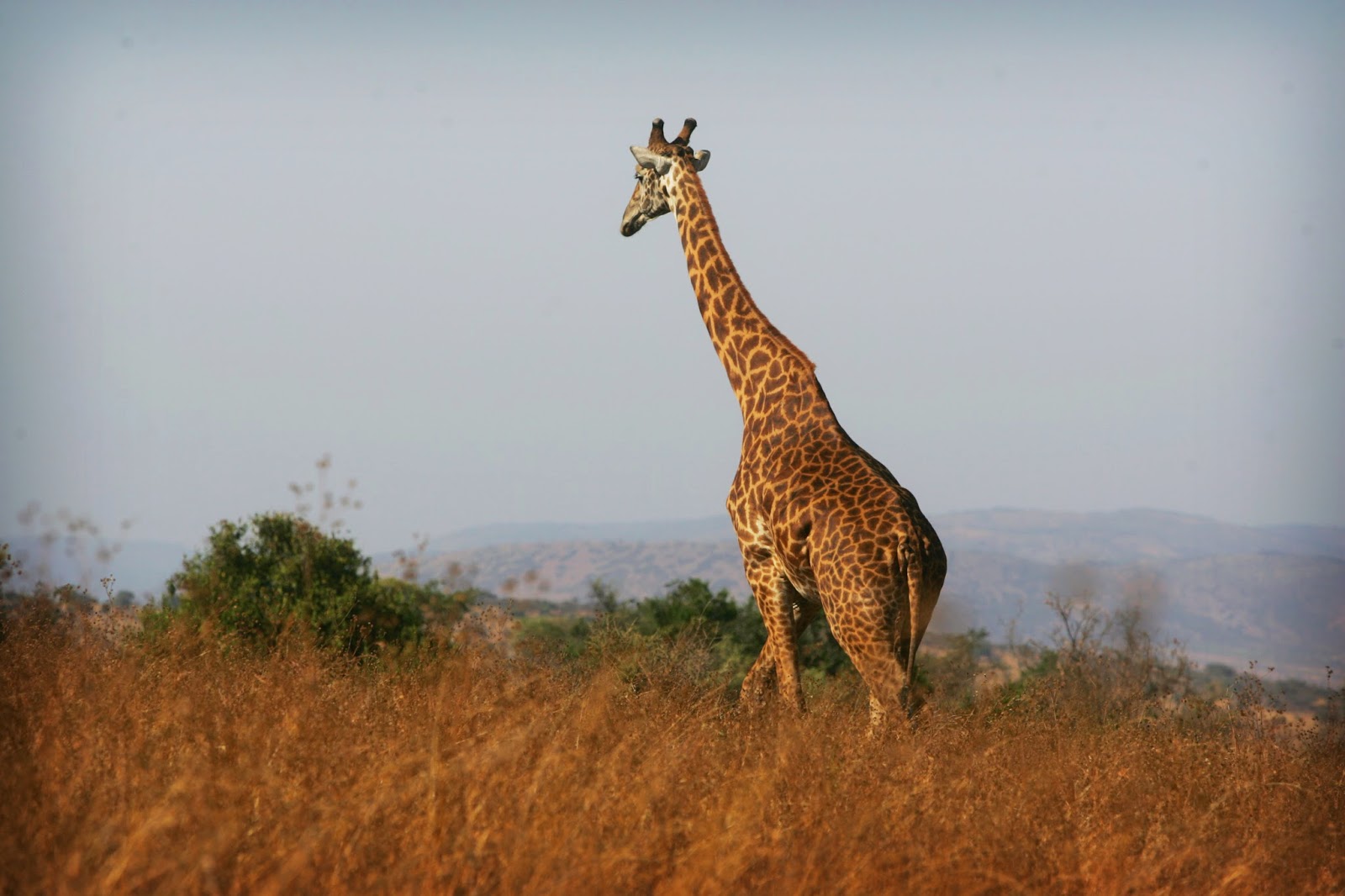
We crept the car along the top of a ridge, past the gazebo that abutted what we half-assumed to be the camping area. As we admired the view of Lake Ihema and wondered whether there were other places to camp further along, our friend, a giraffe, appeared out of nowhere a few dozen meters off the side of the road. (S)he interrupted his treetop dinner a couple times to glance at us casually. I felt like (s)he would have waved at us in a friendly way if it was easy. We gawked like nerds for longer than necessary, then went back to set up camp.


As we pulled in, I noticed a smell of gasoline. I didn’t think much of it, since I was pretty sure I’d been smelling it all day. So we set up our camp in the big open area between the gazebo and the fire pits. 

We had the whole site to ourselves, with far more firewood than a person like me should be allowed access to and a view that we don’t deserve. For dinner we made one of my camping staples that falls somewhere in between jambalaya and Mexican red rice. No secret to anyone that knows me that camp cooking over a fire is one of my favorite things. Especially when accompanied such fine libations as powdered “juice” mix and plastic bottle gin. We stayed up late, dancing around the fire to the music we were blasting from the car. The dichotomy of light and dark caused by the fire and the night let us forget that we were in the wilderness, allowing us to feel free to disrespect the environment around. Later in the night, the glowing green eyes of foraging impala appeared just outside of our illuminated realm. It was cool to see them, but it felt a little like passive aggressive neighbors were telling us to go to bed.

We forced ourselves up just in time for the 6 AM sunrise over Lake Ihema. We needed something immediately gratifying like that to justify the early morning wake-up. After a quick breakfast, we packed the car and headed on our way. On the way out of the site, we hit a big stone that had somehow strayed from the fire pit. It scraped some of the car’s underside, making an unsettling racket. I hopped out and when I looked under the car, I noticed a trickle of liquid coming out of one of the pipes. The damage was not from hitting the rock, but it was still something we needed to look at. The puddle forming under the car was gas. It had been a heavy stream, but after turning off the car, it slowed to a trickle, then nothing. That meant that it probably hadn’t been leaking all night, but we still couldn’t tell how much gas was left. None of the gauges worked.

We wondered if we should go back to the visitor’s center and make our plan from there, or just continue on, hoping that we wouldn’t get stranded. We chose the latter, knowing that even with a leak we would be able to cover some distance, since we had started with a full tank.

I called the guy we had rented from a half dozen times before he returned my call. He told me that even though the gas gauge doesn’t work, the “low fuel” light would come on eventually. From that point, we would have enough fuel to go about 50 km. So as long as we didn’t stray terribly far from the park entrance, we had a decent chance of escaping, while still spending time in the park. We had spent too much money on the park fees and car rental to turn back so soon.

There isn’t much to say about the day. It was enjoyable, although a little stressful. We saw a little bit of wildlife here and there, most notably plenty of giraffes, the sexiest animal on earth.


In the early afternoon, we really felt like we should make a move. We were starting to doubt if that low fuel light was actually functional. We headed toward the visitor’s center and park entrances. As we pushed up the last few hills toward the visitor’s center, the car stalled. With no illuminated warning from the dashboard, our car was out of fuel. We were maybe 2 kilometers from the visitor’s center. Lise’s phone was dead, but mine still had a tiny bit of juice left. I called the visitor’s center, wondering what we should do. As I was put on hold, my phone went dead. I had told them I was out of gas not far from the visitor’s center, but whether they understood or sent someone for us, we did not know.

We waited in the merciless sun for about 30 minutes, before we saw another vehicle. It was a large, shiny SUV, and we waved it down. A middle-aged white man rode in the passenger seat, and I tried to explain our situation. The Rwandan driver stopped the car and they got out. There was a family in the back. They said they would go drop off the family, then come back to tow us. As we talked, I found out that the white man lived in the same region of Rwanda as me. I told him the name of my village, and he said he lived there too. It turned out he lived just 100 yards from my house and was the manager of the cement factory in the village. I had seen him around a couple times, usually playing tennis, but had never actually met him. It was the strangest of coincidences.

Thirty minutes later, the driver showed up with an empty car. He explained that they had talked with the park officials. The officials had said that they would not allow him to tow our vehicle with his. It had to be done by park staff, a service for which I would have to pay. We got in his car and drove to the visitor’s center. After chatting, I found out that the driver’s son went to the school I teach at, and he had actually just attended our boys camp.

We waited awhile for the park vehicle to arrive. When it did, I hopped in with them and we drove back to our car. They tied a rope from their hitch to my bumper and started crawling up the mild hills. 100 yards before arriving, the rope snapped. The guys driving the other car didn’t notice, and they just kept going. I watched as they pulled into the parking lot, got out, and had horrified faces when they realized that the car being towed was no longer there. This was followed by immediate looks of relief when they saw me way down the road.

Lise and I begrudgingly paid the $30 service fee, then tried to get back in touch with the owner of the car. Luckily, the Rwandan wife of my neighbor let us borrow her phone. She had insisted on waiting for us as we got sorted out, offering to wait for us to make phone calls on her phone. Her husband (my neighbor) was clearly getting impatient. I felt bad, but we were really stuck, with two dead phones, and the park refusing to let us use a phone.

Our communication with the owner of the car was spotty, but it seemed that he was coming to get us, and maybe sending a mechanic. After an hour or so, a couple of mechanics from the nearest town showed up and started working on the car. I was worried because I didn’t know if we would have to pay for the repairs, and if so, I should probably have negotiated the cost beforehand. After another couple of hours, the owner showed up in a small car with a Rwandan friend and a Belgian friend. Each friend brought a four or five year old boy. It wasn’t sure why he had brought the entourage, but he mentioned something about how they had been doing work together in the morning, so they all came together on this little adventure.

Lise and I were exhausted from stress and heat. We had no idea what further costs would be incurred for repairs, lost gas, the owner driving out to rescue us, etc. It seemed that the possibility of extra charges could be endless, if the owner demanded them.

It wasn’t until after 4PM that we finally were on our way. The mechanic had repaired the leak with his random assortment of rusty tools and scraps of plastic and rubber. We drove back to the small town of Kayonza where we stopped for dinner. The owner of the car treated us to a buffet plate, while he ate three chapattis dipped in a stein-sized mug of hot, sweetened milk. I was disarmed by his kind and apologetic nature, as if it really was his fault that the car had broken down. We were uncertain about when we had first smelled the gas, but we never said we thought it was our fault. He must have been aware that the car he had rented to us was a piece of junk, and wasn’t even the same make or model that we had asked for.

We arrived in Kigali well after dark, and he drove us back to our guesthouse, which was a considerable distance away from where he lived. In the end, he gave us a fair estimate on how much gas we probably used, and didn’t mention repairs, or the cost of him coming all the way out to the park to help us out. He was a businessman, not a swindler, and new that if he had tried to take advantage of us, he risked garnering a bad reputation. He expressed his apologies and suggested that we refer our friends to him for tours and car rentals. We were simply relieved get out of there without any costs that would have inflicted me with a severe bout of poverty.

It wasn’t the adventure we were expecting, but it was an adventure nonetheless. We had a fun time with a far greater diversity of emotions than we could have expected, and somehow, it seems better that way.

Wednesday, January 22, 2014

Theft in Rwanda


Theft in Rwanda is almost never by force. Nor is it usually through cons or tricks. It is most often through opportunism and stealth. Leave something of, even insignificant, value in a place that is reachable without anyone noticing, and it will likely be gone. At first I thought it was silly how obsessive my host family was with their locks. At night, every cabinet holding silverware, leftover foods, plates and a sugar bowl were closed and locked. One volunteer’s family even insisted that they lock her bedroom door (from the outside) at night. It seemed so silly because Rwanda is one of the least intimidating places I know of, and I can’t imagine people breaking into houses. However, it happens on a regular basis on the village level. People sneak around at night, looking for unlocked kitchens and easy to hop gates. Any objects, including charcoal or unattended pots of food over a fire, are prone to disappearing if not behind a locked door. People are so paranoid of theft in the villages, that when they move houses, they do it in the middle of the night, for fear of opportunistic thieves, and displaying their possessions, which could attract thieves at later times.

Pick pocketing, which seems to disproportionately target foreigners in urban areas, seems to be on the rise. Most incidents occur at crowded bars, but myself and several other volunteers have been targeted on the street. While it seems to be pretty common, I get the impression that Rwandans are still mastering this art, as I have see many failed attempts at getting into my pockets.

The most surprising thing about theft here, though, is not the frequent village thefts and break-ins or the lackluster attempts at pick-pocketing. To me, what is shocking is how tame the aftermath of a theft is. Africa is famous for its “street justice”. Somebody caught stealing is liable to get chased through the streets and beaten, or sometimes even killed. Now, in principle, I don’t condone vigilantism. However, I have found it comforting, and even useful, in the past to know that I could muster a mob or at least a little help just by shouting “thief!” I am convinced that screaming “Help! thief!” helped keep me safe when men on a motorbike were chasing me on a dark street in Ghana. When somebody tries to rob you on the street in Rwanda, nobody else really cares that much; at least not enough to chase them down and beat them. Not that I condone that.

I don’t know if there is a lot of theft in Rwanda. It would seem on the surface that there is. I have seen and heard of a lot more here than any other country I’ve been in. Then again, I’ve been in Rwanda a lot longer and hear a lot more than I did in the other countries I’ve been to. However, I have never heard of any thief turning to violence. And I guess that’s a good thing.

***

We arrived in Gisenyi at dusk, just in time to hear the call to prayer slinking out of the large mosque nearby. Luke, Caitlan and I descended from the bus in the town center where it was moderately crowded with pedestrians. Caitlan was slightly behind Luke and I as we walked in the direction of the bank. Suddenly Caitlain said my name, and that somebody was reaching into my backpack. By the time I turned around the teenage boy was halfway across the street. I remember casually dropping the word thief in English and French, seeing if any of the other pedestrians would care. I watched the boy as he mixed into the crowd and slipped behind a building.

A month later I was walking with Harley in the same town, at the same time of day, on the other side of the street in the opposite direction. Mid-conversation, Harley starts yelling, “Hey. Hey! HEY!” I stopped and turned in time to see the thief running across the street. Harley, who had served in the Peace Corps in Cameroon and was very used to street justice for thieves, was yelling “thief” in French. Again, nobody seemed interested in stopping the guy who had nearly gotten away with Harley’s wallet. A man nearby came up to Harley and asked if he was ok. I guess this was not what Harley was expecting to get by yelling “thief”.


***

Some of my fellow PCVs get robbed on a regular basis at certain bars. One of our favorite dives in one of the lake towns got pretty bad after us gringos started going there more often. Pick pockets generally take advantage of the crowded dance floor, the drunkenness of the victims and the dark. The first time I caught a man with his hand going into my pocket, I yelled at him and called him a thief. He simply pretended he didn’t hear me. It was the same defense that some of my students use when they’re in trouble. Avoid eye contact and ignore. I still don’t know how to deal with that.

The second time somebody tried to pick my pocket at that bar I didn’t notice at first. As happens in Rwanda, I was dancing with a guy. He had started dancing pretty close, which is completely normal. Then, without warning, he just stopped dancing with me. I didn’t think much of it, which was silly of me. Just then, another man on the other side of the dance floor caught my attention and motioned that I had just been pick-pocketed. I checked my pockets and was missing a 2,000 franc bill, about $3. I confronted the man and told him to give my money back. He denied he had done anything wrong, I insisted he had stolen money from me. Other men started to take interest and gathered around. The guy emptied his pockets. All he had was a filthy 500 franc bill. I didn’t realize until later that the first place that stolen goods go is directly into underpants. I smacked his back pockets, and he showed there was nothing in them. I felt there wasn’t much more I could do, and accepted that he had gotten the better of me. The other men at the bar, however did not give up so easily. Soon the guy was in the middle of a mob that appeared to be growing aggressive. The man was pleading with them, and on the verge of tears. Still, he refused to admit what he had done or where the money had gone. Although I had never seen anyone act violent towards thieves in Rwanda, I wasn’t sure this criminal was safe. I was second-guessing my case against him and didn’t want him beaten up in case I was wrong. I went into the mob and grabbed the man by the arm and pulled him away. The crowd followed. I told him he needed to leave and pulled him towards the gate at the entrance to the bar. The security guard closed the gate before we got there and the owner of the bar appeared. He wanted to take matters into his hands and grabbed the thief and slipped out the door of the gate with him. The guard shut the door behind them. The guard didn’t want to let me through, but I pushed my way past him. I didn’t trust the owner either. When I got out there, I explained to the owner that everything would be fine if we just made the thief leave. He agreed and stepped aside. Shockingly, the thief didn’t want to leave. He was weeping lightly and was still trying to tell me he didn’t do anything. I told him I didn’t care and told him to get out of here. I had to physically grab him, push him into the street and yell at him to leave. As he slowly backed away he was yelling apologies. I didn’t understand why he was apologizing and refusing to admit guilt at the same time. Maybe he just felt bad for simply leaving me in the middle of a dance. Because that’s what I do to people that snub me on the dance floor. I accuse them of theft and kick them out of the bar. 


***
Towards the end of the dry season, I noticed a rash of petty thefts in my village. All of them were occurring around dusk, which could have been a coincidence, or just seemed that way because it is the time I am most often walking around the village. The part that I really noticed, however, was the season. In the course of a couple weeks I noticed three small crowds gathering to deal with a theft. Again, they were all peaceful, mostly full of people like me that just wanted to know what was going on. I wondered if there was a reason these were happening late in the dry season. I remember after the bus hold up in the Philippines, I asked someone of if banditry was common in the area. They told me only in the dry season, when food is most scarce. If seasonal food insecurity led to a rise in theft in the Philippines, it would be surprising if it didn’t in Rwanda, where there is a much bigger problem with food production.

***

I saw a rare scene of commotion at my school one afternoon. A little bit of yelling, students crowding in one of the open areas outside. Whatever had happened was over quickly. I asked around about what had happened. Apparently there had been a fight. I asked about the cause and I was told that a boy had stolen another boy’s pen. It was one of those startling moments that reminded me of the reality of poverty. Rural poverty is so much less dramatic than urban poverty, but is very real. Also, I work at a boarding school, meaning that my students are not the poorest in the community by any means. Still, for teenage boys, something as trivial as a pen is worth stealing. And fighting over.

***

Breaking and entering. Yeah, it happens far more than I would expect. It happens to a lot of volunteers when they have been gone for a while. Window bars are sawed, locks are broken, and I even heard of one story where thieves dug a tunnel into a house.

A few months ago, my school became the victim. I walked into the teacher’s lounge one morning and there was a hole in the brick wall a meter wide. I didn’t think much of it. I figured there was some sort of renovation or repair going on. I sat down and went about my business. After a while I started noticing the other teachers entering and acting surprised by the hole. They were talking amongst themselves and pointing at the wall. Still I didn’t really pay much attention. Teachers never really tell me anything, so I’m kind of on my own to figure out these mysteries. I overheard in their conversations stuff about a thief and missing money.

I later learned that a burglar had entered the unlocked teacher’s lounge at night and smashed a hole through the wall to access the bursar’s office, where the school’s money is kept. About 4,000,000 francs, or about $6,000, were missing. In a couple hours a few police officers arrived to look at the scene and question some people. The night security guard was there, and for obvious reasons looked very nervous.

Later in the day I saw the police truck leaving the school with the security guard, the disciplinarian for the girls, and the woman who serves the food in the teacher’s lounge riding in the back. I wasn’t sure what this meant, and I tried to ask one of the teachers, but again, they don’t really tell me anything. I don’t know if they were ever suspects, but the disciplinarian and the server were back two days later. In the mean time, the teachers had to pour their own tea. Shame. I never saw the security guard again. I assume it is because he lost his job, since people tell me that they haven’t found the person who committed the crime yet. If the night guard somehow didn’t notice the banging of a wall with a sledgehammer, perhaps he was just too heavy of a sleeper to be doing security work.

I know very few facts about this case, and people never tell me more than just “nobody knows who did it”. I would be suspicious about what happened, but there seems to be no point. I’m just disappointed that the theft caused our teacher’s meeting after party to be cancelled. The meetings include free beer and it is the one time per term when the other teachers actually have conversations with me.


***

The one place in Rwanda that doesn’t seem to follow the pattern of theft that I’ve seen in Rwanda is Nyamirambo, a neighborhood in Kigali that I’ve mentioned several times before as being an anomaly in this orderly country.

I’ve never seen anything violent really, but I have heard stories of snatchings. I have also seen and heard of the more typical kind of street justice. One night, around 4AM I was getting an omelette on the street. It’s the one place in the country where something resembling street food exists. It is also the one place where staying out that late just happens by accident because there is enough to do. Suddenly I see a guy run down the side street I’m on, with a few other guys chasing after him. One of the guys near me joined in the chase. They caught up with him, and tackled him to the ground. Before they could get control of him, however, he slipped away and started running again. This guy was fast. He turned a corner and seemed to have escaped. I don’t know if he was ever caught, but someone told me that he had stolen a cell phone.

A secondhand story that I must admit has been filtered through a couple different people, so I can’t verify its accuracy. In the same neighborhood, a volunteer was at a bar when she realized that somebody had stolen her iPhone. She was fairly sure she knew who it was and got some people to help her. The man was forced to strip down. He thought he was going to get away with it. When he was down to his underwear, they made him keep going. The discovered the iPhone smashed between his butt cheeks. I probably would have admitted to the theft when it looked like a cavity search was coming. I’ve always been amazed at how far people will take their lies.

***

I feel that I am painting a negative picture of Rwanda, but I don’t mean to. The culture of theft has surprised and fascinated me. It’s not something that I think about or worry about on a daily basis. However, I do worry about it more than I have in other African countries. I don’t know if this is a result of my extended time here. With 15 months under my belt, maybe I have simply witnessed a lot more than I did in the other places I’ve been to. 

Saturday, November 30, 2013

Fighting


Fighting is a strange thing in Rwanda. Countless times I have seen conflict grow, expand, inflate to the point of explosion, only to suddenly fizzle anti-climatically at the moment that fisticuffs seemed inevitable. One person’s mood might change from anger and frustration to playfulness as an awkward smile breaks across their face and he gives a lighthearted kick to his foe and it looks like noogies are to follow. Or maybe just before one person realizes he is about to get punched, he will back down and walk away. I constantly overhear hear empty threats of “I’m gonna beat you” between all sorts of people. In the other African countries I’ve been to I saw a lot of fighting. Ghanaians seemed to love to fight and a friendly atmosphere could become a brawl at a moment’s notice, only to return to friendliness after a few punches had been thrown. In just a couple weeks in Senegal, a country with a remarkably friendly and peaceful atmosphere, I saw at least a couple serious fights. I even got punched in the face in Mali, a place that has a special place in my heart as one of the most hospitable countries on earth.

I don’t know if I can explain exactly why casual street violence seems suspiciously absent from Rwanda. It may seem strange in a country that has such a violent history, but then again, when living here, the violent history seems almost impossible to comprehend. We can hypothesize, for example, that people are tired of violence and reject it now out of principle. Or maybe it’s something completely different, I don’t know.

***

The bus station in Gisenyi is probably the most aggressive in Rwanda. The station in Kigali is a little bit chaotic, but mostly because it is the central transit point in the country. Nothing about it feels too intimidating. The station in Gisenyi, a town that borders the DRC, is not too busy. There are at least 3 or 4 bus companies, but all busses go to the same place. This creates fierce competition. Tourists and Rwandans alike get eaten alive by the occasionally drunk ticket hawkers if they are not firm about what bus they want to get on. I assume that the ticket sellers are Congolese since they only speak to me in English or French (as opposed to Kinyarwanda). The prices are all the same, so it’s best to get on the bus with the most people waiting, as it means you will leave sooner. The ticket sellers will lie about when the buses are leaving, but it’s best to just get on the fullest bus.

When Harley and I arrived at the station people fought over us a little. Arms were grabbed, little shoves and lies were dispensed freely and we eventually chose our bus. As we were starting to leave a large, middle-aged woman arrived. Our bus stopped to let her on. Then an argument ensued between two ticket sellers over her. Someone tried to grab her arm and lead her away. The dueling touts started to shove each other as the woman scurried onto our bus. As the fight started to get going, a man wearing a donated Foot Locker uniform came in to break it up. Considering his black and white striped shirt, I wondered if he was the designated referee of the bus lot.


***


My bus home had left far later than expected and by the time we arrived at the scene of the accident it was dark. I couldn’t really tell what was going on, but another bus was parked 50 meters in front of us near a taxi and behind us was parked private car. A small crowd of people had gathered in the middle of the road. It seemed that there had been a fender bender involving at least two of the present vehicles. I watched the unruliness in the middle of the road grow until there was shouting, wagging fingers and eventually shoving. Some of the people from my bus had gotten out and joined the fray. I was counting down the seconds until the mob devolved into an all-out brawl. Then, like an impending thunderhead that dissipates before cataclysm, the crowd and conflict just evaporated. People started to walk away and it got quieter. I assumed the cops had just shown up, but this wasn’t the case. I have no idea what happened.

Five minutes later, a smaller scuffle was developing between two men. The shorter, squat man was pushing his opponent and yelling. It was clear that the taller man didn’t want to fight, but he wasn’t going to just back down yet. They were yelling, and the one-sided shoving continued. Finally, the shorter man reached his hand back, swung toward the tall man’s face and struck him with a loud slap across his cheek. The slap shocked him, but did not provoke him to violence. He just turned around and walked away. I couldn’t believe it. Somehow that was the end of it. The police did indeed show up a little later, but order was somehow restored long before they arrived.

***

A lazy morning in Kamembe, I left Lise’s house to scavenge some food for breakfast. Chapatti if I was lucky, bread if not, maybe some avocado or eggs. As I reached the area where the women sell their vegetables on the side of the road, I noticed a small crowd of mostly women standing on a big dirt mound. Hunger and heat curbed my curiosity. I found a shop that had two dry and cracking chapattis from the day before. I bought them, an avocado, onions and garlic. Having finished my work for the day, I snooped around the crowd on the mound. I realized that they were all gathered to watch something else. We were on the edge of the dirt yard in front of a small shack with the door open. Two men in ragged red uniforms were in a standoff with a couple of young me. Things were clearly heated between the two parties. The men in red were part of the most local of police, which are really like local volunteer security with basic training and an even more basic uniform.

I don’t know how it happened but suddenly the two pairs were locked in battle. The taller man in red was waving his nightstick around as the wrestling ensued. The market women were whooping and screaming. He connected on one of the young men’s head a couple times before the man getting beaten managed to grab the club. The security officers were not poor fighters initially and now that they had lost their club they were in worse shape. As the club was waved around on the other end, the officers started to retreat a little. One of the civilians had a bloody wound on his head from the club.

As the two sides separated and the shouting and finger-pointed started again, some of the women grabbed rocks. This already was, by far, the most aggression and violence I’d seen displayed in my year in Rwanda. Now I was about to see the most impressive display of Rwandan women being assertive and forceful I’d ever seen. As the four men went at each other again, the women hurled their rocks at the security officers. These weren’t pebbles either. They ranged in size from baseball to seedless watermelon. A couple of smaller rocks connected, but not hard enough to inflict serious damage.

I asked people what was going on, but people simply told me they were fighting. I was never able to find out what was going on. It was fascinating, though. I’d never seen anyone in this country stand up so forcefully to any sort of authority figure.

The brawl went on and off again for another 15 minutes. I kept waiting for military or police to arrive. Military and police have a huge presence all over Rwanda and their absence here was shocking. In fact, just 50 feet away there was almost always a soldier posted at the intersection.

Eventually the officers managed to subdue one of the young men. He struggled for a few moments, but then submitted. One of the market mamas ran up and started screaming at the officer and grabbing the boys arm, telling him not to go with him. There was a moment of confusion, and the young man broke free, kicked one of the officers and scampered off. Some more rocks were thrown and the officers started to leave.

Then it all started again, and within a few minutes the officers finally had the man with the bloody head under control and they led him down the road. The mob followed them. The women yelled at the officers as they marched away.

 I couldn’t explain what I had seen. Nothing like that had ever happened before. I was happy, though. It was the most passionate and emotional I had seen Rwandans. It was the most confidence I had seen the women show. It was the most rebellious I’d seen in Rwanda. I’m not saying I think people should be violent or unruly, but I was glad to see people stand up to an authority figure that was clearly in the wrong.


***

During the pickup games of basketball I often play in the village, I am always shocked at the lack of emotion when playing. When someone stuffs someone, or scores an acrobatic point, seemingly embarrassing the defender, I never see any taunting or showboating. In fact, I think I was the only one who I know of who has discussed taking someone to school, or kindly informing them that their shot will not be welcome in my house. It’s certainly not like street ball in America. Arguments occasionally break out over disagreements of fouls, but they never get too serious. This is not a fight story. This is a story about how I’ve seen countless fights break out in basketball games, especially at three-on-three tournaments, in America, but have never seen one here. I think I’m the only one who has ever come close to hitting someone out of emotion competitive spirit.

***

I was with my parents on a bus to my village. Twenty minutes outside of the main town a tall man got on. He was being a little loud and friendly with everyone. I thought I caught a whiff of alcohol on him from a few feet away, but thought nothing else of the man until it was time for him to get off.

As he tried to depart the bus, the ticket-taker asked for his fare. He just ignored him and tried to walk past him out the door. The ticket-taker stood his ground and refused to let him out. They began to argue as the man tried to push his way out. The ticket-taker started to reach for something under a seat. It was a long piece of rebar. The man started to relent, then suddenly pushed his way out the door. The ticket-taker grabbed the rebar and rushed out of the bus amidst a few shouts from other passengers. What happened next was unclear to me. I could not really see what happened, but it seemed a minor scuffle ensued as the ticket-taker raised the piece of rebar threateningly. It seemed that nothing really happened in the end. The ticket-taker went into the nearby bar, and I don’t know what happened to the man. When my mom asked what they were doing, I said that the bar was going to pay the fare and the man would have to work there to pay it off. I was joking, because I really had no idea what was going on. Ten minutes later, the ticket-taker returned with a small bandage under his left eye and another small bleeding cut on his cheek. He seemed surprisingly calm. And that’s all that I know about that.

***

I was on a local minibus in Kigali heading into the Nyamirambo neighborhood. As usual I was sitting in the least desirable seat in the far back left corner. This meant that when I got off, about 6 other people would have to get out to let me off. I was getting off at the first stop so I was not looking forward to the minor annoyance I would cause everyone. When we stopped, I saw that something was going on. Kids and a few adults were rushing across the street and there was some yelling. I assumed something interesting and unexpected was going on nearby, and the looky-loo that I am, I wanted to see. I started to climb out the back window, which I thought would be a move appreciated by my fellow passengers. I was stopped, however, by the uptight, rule-following young men next to me. Also, as it turned out, everyone in my way was also getting out at that stop.

I hustled across the street and up the side street next to the mosque to where the crowd was forming. In the center of the crowd, right in the middle of the street was a very distressed-looking naked man. He was completely naked. It quickly became clear that this man, who had started crying, was an “umusazi”, as it’s known in Rwanda, or a “madman” as he would be known as in Anglophone Africa. Basically someone with some sort of unclassified mental condition which leaves him as something of an outcast, left to walk the streets and usually fend for himself. There was another umusazi or two that seemed like they were trying to provoke him and pick a fight with him. That he was naked made me originally think that he was a thief, and had been disrobed to find his loot and to shame him. It was clear that this was not the case as the Muslim men tried desperately to wrap him up with cloth and then a filthy jacket. The umusazi refused them outright. He ripped the jacket from around his waste and tossed it aside. All the spectators were laughing at the man. I was curious, of course, but felt seriously bad for this man who just wanted to be naked.

After shaking himself loose from the other umusazi, and the would-be dressers, he pushed his way through the crowd and walked down the street. I thought this was the end of it, but before I knew, he had gotten himself into a scrap with shoe vendor, (a shoemucuruzi, if you will). I don’t know what provoked it. It could have simply been the shoe vendor not wanting to be around a naked umusazi, but it seems that the umusazi had done something to initiate it, perhaps by messing with the guy’s shoes.  They were shoving and punching for a few moments as the crowd ran toward them to watch. A gasp went up in the crowd as the umusazi picked up a volleyball sized rock. He lifted it over his head as the shoe vendor started to back up. The umusazi jumped and threw the rock in mid-air. It landed about two feet in front of him. So he picked it up again and threw it pitifully again. By this point, some of the young guys who seemed to have social authority in this neighborhood had grabbed him and forced him to the ground. They quickly got some cloth and bungee cords from somewhere and someone and tied his arms and feet. The man started to cry again, while the crowd laughed. I don’t want to judge too hard for the Rwandans’ laughter, but I’m not the only one who has noticed the people here laughing most heartily at other people’s misfortunes, although it is technically illegal (yes.).

The Muslim men returned to drape clothing over the man. It was a kind gesture, but it clearly upset the man even more. Maybe it was not for the sake of the umusazi, anyway, but to protect the gawking crowd from the indecency. As he tried to struggle out of his makeshift shackles, some of the men subdued him, forcing him to sit or lay down, as the shoved their feet into his chest and face. He seemed to understand and accept that he was being detained after a while, but he really wanted to stand up. The others did not want him to and it caused a continuous struggle. The umusazi continued to cry.

After a few minutes I walked across the street to get to my hotel room. I just needed to go there to charge my phone. So a few minutes later I returned to the crowd. All of a sudden the man broke free of his wrist straps. Surprisingly nobody tried to re-tie his hands together. I had been hearing murmurs about whether the police were coming. This was another situation that I was surprised not to see the police. Frequently I would see soldiers marching around the neighborhood, but maybe they are just for show. Nyamirambo is not like any other place in Kigali, and they seem to play by their own rules, and it seems that the police do not matter as much there. I had told Harley to visit the neighborhood because I like it so much. When he returned he said, “I didn’t see what was so special about it. It jut seems like any other African neighborhood.” Exactly. It is the kind of neighborhood where these chaotic events still seem to happen. Plus, it is in a city that has more order and cleanliness than almost any other I’ve seen in the world.

After the umusazi broke his hands free, he tore off the lashing from around his ankle. Again, nobody did anything. He stood up and just confidently walked through the crowd to the middle of the street and started to walk. He continued down the middle of the street, buses and cars calmly going around him. A column of spectators followed him, laughing and wondering what would happen next. He was marching with confidence; leading a parade, really. I followed for a short way, and was happy that people were leaving him alone. I stopped following after a few minutes, but continued to watch him strut down Nyamirambo’s main artery for a few hundred meters. I couldn’t help but wonder where he was going, and what adventures he would get into. Unfortunately I knew that wherever his day ended, it probably wouldn’t be a very good place.

***

So what do all these stories say about Rwanda? I don’t really know. I started by writing about how rarely I see people fight, and then proceeded to right several anecdotes about people fighting here. I hope, though, that it’s clear how rare these instances are and that they are mostly mild incidents for what I know of Africa. To me, it is most interesting to think about what this culture of mild manners says about its violent past. Has everything changed, or was it always like this? I can’t really know, but I hope that by the time I leave I have a better understanding of this and many other things that I find so confusing about Rwanda.