Showing posts with label Malaysia. Show all posts

Wednesday, October 5, 2011

End of Malaysia

July 25, 2011

We set out from Kota Kinabalu, hoping that we would be able to make it to Sandakan before dark. From Sandakan we would be taking a boat to the Philippines. The schedules, unfortunately are pretty elusive, and when we set out for the town we had only vague information that they might make their weekly departure that evening or the next morning.


We had no plans of taking the bus, and had a good feeling that hitching would be almost as fast. Because I am writing this nearly two months after the fact, my memory of all of our rides is a little hazy.


I am fairly certain that our first ride came quickly with a wealthy man in an SUV. He took us perhaps a third of the way on our 200 km or so journey. We ascended for the first time into some mountains. For the past year I felt like I never got more than a few hundred meters above sea level, so this was a welcome treat. I could see why this place attracted so many tourists. The jungle covered slopes looked rich and inviting. We eventually reached the base of Mount Kinabalu, the tallest mountain in Southeast Asia. It is supposed to be an incredible climb, but the permits and costs made it out of our reach.


Eventually our driver took us to his town, gave a small tour around, as many Malaysians had done before, then put us back on the road in a good spot for our next ride. It took a little longer than expected, but our next ride, a young man in a sports car who knew no English. We had no idea how far he was taking us, and unfortunately it was only a few km. Next we caught a ride with a guy who was vague in his explanation of where he was going because of his rough English. We knew there was basically one road, so we figured it was ok to get in with him. After 20 km, he turned onto a side road and said he had to pick someone up and take them back to where we would come from, he said he would be back for us. Something about the guy seemed off at this point. At first he said he was not going to Sandakan, but now he said he would be going to Sandakan, after dropping off his sisters in the nearest town. It seemed really suspicious, so we hoped that we wouldn’t need to get a ride from him when he got back. Luckily, after half an hour, two women in a massive SUV pulled over for us. They welcomed us in and say they were going almost all the way to Sandakan. Perfect. Long ride, no suspicious guy, we were on track to make it faster than the bus.


It was a really unique thing to get picked up by two women. It wasn’t rare, in many countries to see women driving alone or with other women, but it was the first time I had ever been picked up outside France or America with just women. They were very friendly and could stumble along in English. Unfortunately our Malay never developed beyond pleasantries and food.


They brought us about 20 or 30 km from town, close enough that it felt silly not to just jump on the next local bus that passed. We preferred to hitchhike, but there was a lot of traffic, and nobody was stopping because of how many busses there were.


Sandakan was very different than Kota Kinabalu. It was the first place in Malaysia that felt truly slummy in parts. Lots of clothes hanging to dry in the windows, kids running wild and half-naked in the streets playing games, piles of trash, etc. It was the first time I had felt sketched out just walking in the street at night in a long time. It fit the bill of a port town. Money changers and pawn shops at every corner, plus plenty of prostitutes.


At the night market we found lots of Filipinos. Being the closest port of entry to any country to the Philippines by boat, it made sense. Already we could notice some different styles and mannerisms from the Filipinos, though telling them apart from their face was a bit mysterious. They were obviously much poorer and they seemed to occupy the dirtier half of the market, selling fruits and snacks.


We also spent much of our night trying to track down accurate information about boat departures. We had learned little from all of our sources. There were two boat companies, and one had a website with information that seemed accurate. The other one had no website. We tried calling both of them, to no avail. We later found out that the company that still had a website was the one that had since shut down. We went to several hotels to ask and were met blank stares. I checked various traveler websites, but couldn’t get any recent information. The best we could come up with was that a boat might leave the next day at 6 AM, but maybe not, and if not, probably not for several days.


So we set our alarm for 4 AM, allowing time for going through customs and immigration, left the France Hotel, and searched the empty streets for a taxi. The driver seemed pretty quiet about his knowledge of an early morning boat. That should have been a sign.


We got to the port, far from town, and it was dark and empty. The taxi was gone. We walked around, next to huge fences, gates and mountains of shipping containers. The only people around were a few women opening up their food stalls. That seemed like a good sign. The women didn’t know anything about the boats, so we found a security guard. He said he thought it was at 4:00 PM. By 7 AM it seemed obvious that we would be in for a wait. We ate freshly prepared food from the stall, then I set out looking for information. I had managed to find out where the boat company’s office was back in town. By now public transit was running so getting to town was pretty easy. I got to the office before it was open, and had to hang around the neighborhood This was a treat, though, as it seemed even rougher than the neighborhood before. Everyone was rising and getting ready for the day. It was a good feeling to watch the neighborhoods wake up and join them for a morning coffee.


Back at the ticket office, they said the boat would be at 3:00, but that I had to pay in cash. It would be one of the first times I was ever planning to pay for something with a card. I figured paying for 2 $80 boat tickets wouldn’t be a problem, but I guess it was and I needed to go visit an ATM. Another bus farther into town, finding an ATM, then finding a money changer to exchanging a small wad from Ringgit to Pesos. Back to the boat office, I got the ticket and was on my way.


When I got to the port, Lise seemed a little bit exhausted. Obviously we hadn’t gotten enough sleep, but she had grown annoyed with the attention she was getting with the men that had shown up. It was true, she was getting a lot of stares. I noticed when approaching that I was getting a lot more attention as well. Malaysians were generally polite and didn’t stare in an ogling way. But now we had entered the port area, we were more among Filippinos and things had changed. Several of them had already approached her for small talk, and one of them, already drunk at 11 AM had greeted me with a handshake that didn’t let go and then asked for some money. We knew we couldn’t wait at the same table we had eaten at for the next seven hours around these leering men, so I went in search of some shade and privacy. On the other end of the parking lot, there was a small grassy area next to a fence. I rigged up my tarp up to make a shade attached from the fence and staked into the grass, then put the rain fly of my tent for a floor. There was enough shade for both of us and nobody could see.


A couple times we thought me had come over to have a look at where we were, but both times it was just people coming to get their cars. I noticed that people were starting to accumulate around the gate by 4:00, so I figured we should get a spot so we weren’t last one through customs, and therefore last one on the boat. It was a 24-hour boat ride, so we really didn’t want a bad spot.


All sorts of hustlers, mostly money-changers, milled around us, offering services and suspicious conversations. We were glad when the gates finally opened at 5:00. They only got us to another locked door, and the crowd pushed and shoved for position. Lise and I were a few of the first people at the gate, but at this point, even trying hard not to get pushed around, we had lost considerable footing. The gate had only opened to allow trucks into the port so goods could be loaded onto the ship. Porters carried bags through the crowd, yelling and pushing their way through towards the doors. Every time a path opened, people tried to jockey for position in the leftover space. Several people had almost knocked us over as they pushed through us. Even when nobody was moving, people were knocking legs, rearranging shoulder into better position, and avoiding eye contact from those they moved in front of. After half an hour in the stifling crowd, they finally opened the doors, we hadn’t lost too much ground, but we knew in this moment we couldn’t lose focus. People stampeded through, heaving all their luggage, nearly knocking each other over. We saw x-ray machines, but nobody else cared, rushing past them onto the next door. The officials yelled and screamed at everyone to get back and put their luggage through the scanners. Luckily we were right next to them and quickly threw ours onto the conveyor belts. Some people came back, but most just pushed past the officials, neglecting the entire security process, marching right to the immigration desk. Even in that line, people were shoving and blatantly trying to cut in front of each other every time the line moved. After we had formed a line, some people made a second line right next to us, and would force their way in front of the people in our line. Nobody would look at the person they were cutting in front of, and nobody would complain. It was bizarre, but after a guy cut in front of Lise, she actually turned to him and told him that she was in front of him and he let her go. We later found out that he didn’t even need to wait in the line as he was Malaysian and didn’t need an exit stamp, but he still felt compelled to have the better spot in line. Even as I was answering the questions as the official looked at my passport, the person behind me hung on my shoulder so they wouldn’t lose their spot. They were the most cutthroat lines I had ever been in.


We got a good spot on the boat’s upper deck, since everybody else preferred the lower deck for some reason. We expected all the beds to be full with family’s spilling out of every nook and cranny. It was like this on the bottom floor, with little room for relaxing. Upstairs we had about half the deck to ourselves and we spread our stuff out accordingly.


Stilt Village in Sandakan, as seen from the boat.

Lise enjoying her beef curry.


Loadin' the boat. It's really more a passenger-funded cargo ship.


Gotta get the Philippines their bottled beverages.


Wednesday, September 21, 2011

Island antics...Not what you'd expect.

July 23, 2011

The customs area to re-enter Malaysia from Brunei was full of cocky, well-to-do young Bruneians, I could only assume were on a weekend trip of sin. Pulau Labuan, just a short boat ride from Brunei, is a convenient place to indulge in vices unavailable in Brunei, such as alcohol, gambling and who knows what else.

Although this was a small tropical island, there was little evidence of paradise in dingy port town. It was urban and not much different than the other Malaysian cities we had been in. There was definitely a little more edge to it, though, as a thriving port that had enough autonomy to avoid Malaysia’s exorbitant taxes on things like alcohol.

As usual, we went looking for a budget Chinese hotel that was significantly cheaper than anything in the Lonely Planet. It wasn’t looking so good, so Lise sat with our bags while I searched high and low. I couldn’t find anything for less than $20. Then we remembered the flyer somebody had handed us after getting off the boat. It was for a guesthouse called “Uncle Jack’s” and the way it advertised wreaked of the kind of overpriced place that some foreigner (I guessed Australian) had set up for backpackers that were too afraid to spend some time on their own and needed to be around other travelers and probably some western food. But with a room for $13 (more than we are used to paying, but cheaper than anything else in town) we had no choice. Sure enough, when I walked in, I was greeted by a variety of traveler types, none of which I could peg as the one in charge. They all tried to show me around, but couldn’t really give me solid information. Eventually a young Malay woman sorted things out for us and got us to our room.. We set our bags down and headed out immediately looking for some dinner.

We wandered past a dozen Chinese, Halal and Indian restaurants, before one that looked cheap enough. Although the prices were not posted, by this point we knew how much certain dishes would cost in a place like this. The food was great and we washed them down with a couple duty-free beers. I had a clay pot noodle bowl, some mix of noodles, vegetables and meat that has been cooked in a clay pot. I don’t know what the clay pot does other than make it awesome. Lise had Tom Kha, the tangy Thai seafood soup that is common here as well. When we got the bill, though, we were surprised how much they were charging us. Instead of $1.50 or $2 for each of our meals, they were charging $3 each. I can be timid in the situation where I think I am getting ripped off, but can’t really prove it. Lise on the other hand can be surprisingly forceful. When Lise called over one of the younger servers and asked the price of the dishes, she made it obvious we were being taken for fools, because she hesitated and instead of answering us, asked the woman in charge. There seemed to be a lot of confusion surrounding us, which we took for dishonesty. Lise had the woman come and sit down for a chat and explained that we were obviously getting ripped off and we had never paid this much before for these meals. The woman’s English quickly degraded to avoid explanation, and just repeated the same sentence about this being the right price. Then the woman who was obviously in charge, said she wasn’t in charge, and the person who was had left. When will they be back? I don’t know. We went round and round, Lise getting angrier and more forceful. I really thought she was going to guilt them into giving us a decent price, but they stood firm, though nervous. When we left, we said we would be back to talk to the person in charge, but this did not phase them.

So back at the guesthouse, we ran into “Uncle Jack” and he was not Australian at all. Nor was he foreign. No, this was an ethnic Malay with a good humor and a sense of how to market to westerners. We also got to know the residents of the guesthouse, a fine mix of bold travelers. The whole crew made me regret stereotyping the whole place after just seeing the flyer. We had a Portuguese guy who had been extending his trip (or maybe affording his trip?) by always looking for whatever work he could get. Like most guesthouses, he was staying here for free by doing whatever odd jobs the owner could find. Then there was the Latvian guy who was a seasoned couchsurfer and hitchhiker. He had a little bit of an elitist attitude, bragging about how light his bag was and how many references in couchsurfing he had. I am sure I have come off like this more than once, though, and I still admired his travel ethos. And finally there was the Malay girl of Tamil Sri Lankan descent. She had been hitchhiking around with the two guys for a while, and had some other adventurous stories of her own, plus a lot of style. Travelers are always quick to classify people from other countries, but for me, so far that has proven impossible for all but a couple nationalities. However, I have started to notice that the travelers from some of the less wealthy countries make the best and most hardcore travelers. For people from Eastern Europe or Portugal, they can’t make the big bucks quickly like in Sweden or Australia and just blow it all on a three month trip. They learn to see Europe by couch surfing, camping, hitchhiking because it is the only way they can afford to do it. And then they realize how it’s the best way to travel and push it to the destinations further beyond.

Uncle Jack quickly invited us to the bar below, where he promised he was buying the beer tonight. Sold.

Uncle Jack switched back and forth between our table and a table of Malays sitting nearby. He got drunk and told all sorts of tales loudly, as we all swapped our own travel stories more subtly. He kept more rounds coming to our table before we could even finish our first bottles. During a conversation with the Latvian about India, Uncle Jack jumped in and started complaining about Indians, only justifying his attitude with the accusation that their masseuses, unlike the ones in Southeast Asia, have very strict barriers of what they massage. A flimsy argument, I thought, but entertaining nonetheless.

Our guesthouse owner and bankroller of the night eventually got bored or drunk enough to lead us to the nearest karaoke bar. It would be our first time indulging in what is arguably Asia’s most ubiquitous form of entertainment, and Jack’s beer-supplying was keeping our singing abilities confident. The Portuguese guy and I shared the song “Country Road” (who sings that?) but he knew the song far better than me. Then Lise and I tore down the house (or embarrassed ourselves terribly in front of all the confused locals) with our duet of “Poker Face”. Our songs and singing were very uncharacteristic compared to the constant love songs that everyone else sings very seriously.

When we left, I am sure we still had unfinished beers on the table, since Jack just kept sending them over. I asked the travelers how Jack makes money, because he seems to do this every night. I am sure he made almost no money off Lise and I taking into account all the beer he was buying for us.

We had a great night, and it was actually refreshing to hang out with some other travelers, especially a group as fun and interesting as this. Borneo is very touristy, but most people have such big budgets that our paths rarely cross.

We had nothing more to do in Pulau Labuan, or Malaysia, for that matter. We were now more than ready to move onto the Philippines. The northern state of Sabah is a big draw for tourists, but all the attractions of diving, mountain climbing, jungle trekking and visiting nature preserves are not backpacker material and we had to get our move on.

The boat from Pulau Labuan to Kota Kinabalu, the capital of Sabah state and tourism center for this region was rough, but not deadly. We arrived to a bright and shiny big city with a thriving tourist center. The neighborhood was crawling with pasty people flaunting all their brand new outdoors wear and clean backpacks. We felt pretty out of place. There were fancy hotels and less fancy hotels posing as hostels. In some places, I have noticed, that the word “hostel” has become exploited and they come nothing close to the basic budget accommodation I expect. Sure, it’s a dorm bed, but if you are paying $20 for it and you have wi-fi and a continental breakfast included, it just doesn’t seem right. Just around the corner, we discovered an empty, but basic hotel with rooms for about $8. They were everything we could hope for in a room: clean sheets, a fan, and a window.

We visited the night market that night, but were somewhat disappointed as it was the first time people had been inflating prices for us at a night market. We realized that it was because so many tourists were around. At the other night markets in Borneo, we had seen one or two tourists in each night market, but this place was crawling. The atmosphere of everyone yelling out to us, trying to force their grilled fish on us was new and less enjoyable, so we didn’t linger too long.

Nothing about KK was very appealing to us, making it that much easier to press on the next day toward the end of our time in Borneo and onto a new country.

Sunday, September 11, 2011

Hitchin', Campin', Cavin'


After closing down the Sibu Market, Lise and I had our sights, nay, or mouths, set on Bintulu, the next city along the main highway crossing the Malaysian state of Sarawak in Borneo. Our plan was to get feet, nay, or thumbs wet on the hitchhiking in Borneo.


We took a local bus out of town to the next village. When we got there, we were quite the sight. Nobody knew why we had stopped in their village, they just kind of stared from a distance. We walked out of the village to avoid the stares and confusion.

The thumb is all for the camera. Hitchhiking here requires you're whole hand out, waving up and down.


Most cars that passed seemed too amused by the presence of two foreigners in the sticks with their arms out to realize why we were doing this. Finally, a guy pulled over for us. He was not going all the way to Bintulu, but could drop us off before he turned off the road for his home. He drove a small sporty car, with some of the plastic wrapping still on the seats. He said he had had the car for two years. Most cars in Malaysia were pretty new, but it still seemed funny to leave the plastic on the seats for that long.


After getting dropped off, we only had to wait about two cars before catching the next ride. It was with a young man who also had a small sporty car, with even newer plastic wrap on the seats. He said he had just picked up the brand new car in Kuching and was delivering it for his brother. He already had the obligatory Islamic decorations emblazoned with Arabic script dangling from the rearview mirror.

He said he was going to Mukah, and we said, ok, just drop us off there. He seemed surprised. He said, ‘are you sure? You really want to go to Mukah?” “Yes, yes,” we responded, “please please, take us to Mukah!” He turned left, almost immediately, off the main highway. I grabbed for my map, and quickly realized that, no, we did not want to go to Mukah. I understood why he had questioned our desires, but he was cool and even drove us back to the turnoff.


It wasn’t long at all before another new car stopped for us. I really hate hitchhiking in new cars. As soon as I get into them, with their pristine leather seats and blasting air con, everything smelling fresh, I get a double dose of self-consciousness, fully realizing how much I must smell, and that my bag is probably soiling whatever surface I put it on. But I don’t hate it enough to not hitchhike. Maybe these are the things that give us all the hospitality we are blessed with when hitching. Maybe, the upper class are the type that realize that it is possible that there are westerners that are not rich, and even though they are traveling it does not mean they can always afford the same luxuries as the local in the SUV. I might have issues with the class divisions in the developing world, but even at my dirtiest, the upper class

has (almost) always treated me well. Unfortunately it is not hard to understand why.


So the man was going all the way to Bintulu on a business trip. He told us all about the city about Borneo culture. He informed us that we could, in fact, arrive at most longhouses anywhere in Borneo, and the people would be happy to take us in for the night. This excited us, and we though me just try to do this. We realized, after being on the road, that this would not be too difficult, as most of the rural areas, even along the highway, had plenty of longhouses, some more modern than others.


The man took showed us the town and where all the cheap hotels were, and invited us for a drink. Being a Muslim, this meant iced tea or juice, but just as good I figured. He ordered some dumplings and snacks for us to share, and then we went on our separate ways.


Like in Sibu, we went after the night market. It was clearly inferior to the one in Sibu, but it still served its purpose. The most interesting thing we noticed about the town was how the commercial strip on the edge of the river that we were staying on gave way to old, wooden slums merely by crossing the street. On one side of the road was 5-story hotels, on the other side, wooden shanties on stills. It was surprising to me, as my first impression of Malaysia was that it was one of the least class-divided places I had been. Maybe I didn’t look hard enough, but I never saw slums in Kuala Lumpur. Sure there were many rich people, but I didn’t see anyone living in squalor. I still don’t know if my perception about Malaysia is accurate, but this was a shock to see. (Just saw a statistic that shows Malaysia’s income disparity as just below America and the Philippines, somewhere around 50th in the world)


We took the same approach to hitching the next day on our way to Niah National Park to check some caves. We took the local bus to the outskirts of town and got a ride within minutes. Another big clean car, this one an SUV. It was a researcher for a palm oil company and his driver. He goes around to the palm oil plantations to conduct research and also to instruct in the proper methods of palm oil farming. In much of Malaysia, the jungle has been replaced with palm oil fields as far as the eye can see. It actually creeped me out the first time I saw it, probably because I knew that it is so bad for the environment. I wanted to ask his opinion about the environmental impact, but knew certain etiquette of politeness should be followed when hitchhiking. Also, the guy was super nice. He was going very close to where we were going, but still insisted on driving the last five km to our destination. He even offered to pick us up the next day and drive us to the nearest bus station. He gave us his phone number to call him when we were ready. Oh, and he also stopped along the way at a truck stop to have a coffee with us.


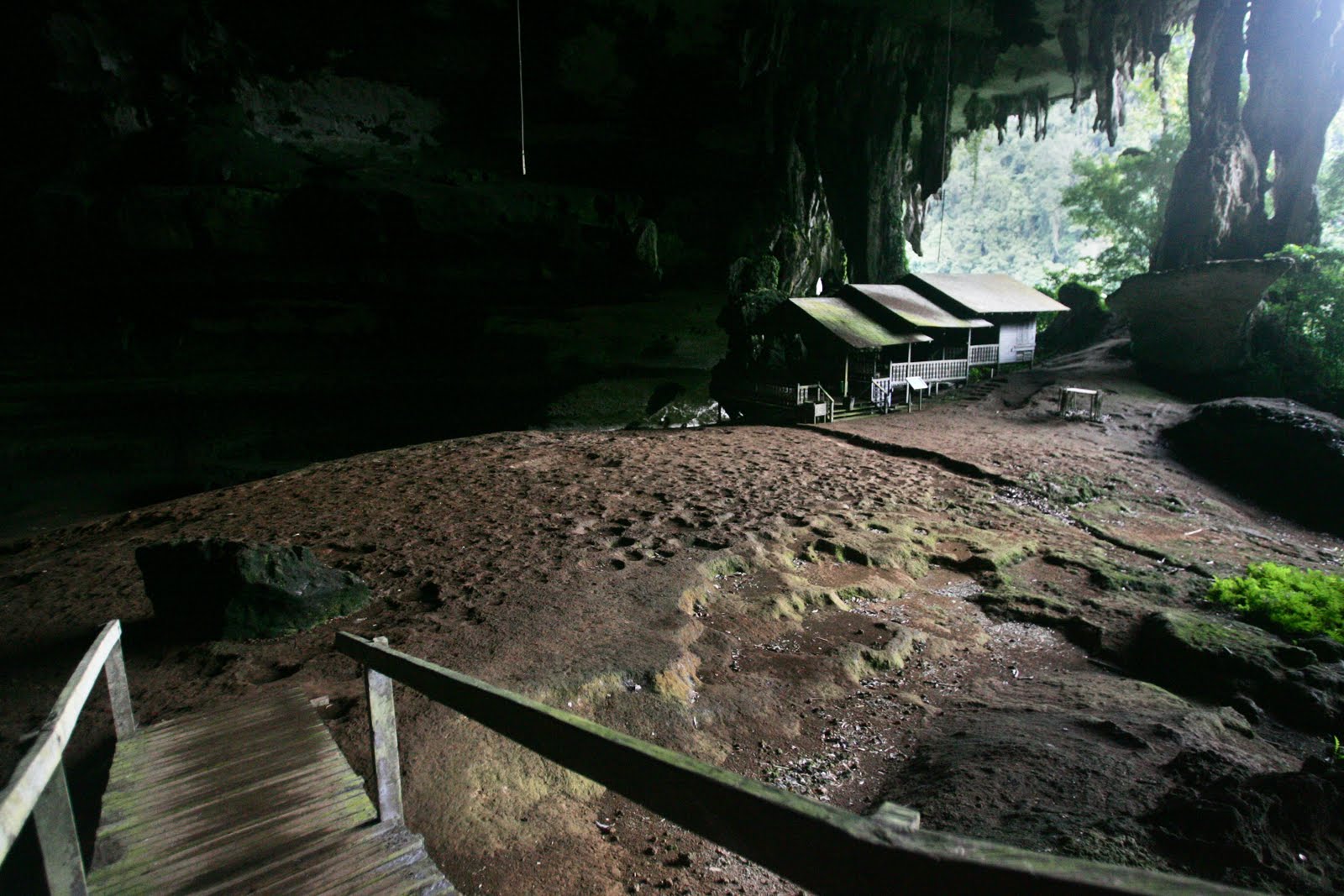
Niah National Park is known for their caves, which house some incredibly old paintings and burial sites. We debated going out there as soon as we got there, but it was a three km walk and we only had two hours before sunset. We camped at the park since it was far cheaper than the guesthouse. Although we had to pay, it was an informal camp spot. Just anywhere on the grass, we were told. We were 20 meters from the cafeteria.


We should have made a better effort to get to the caves earlier. We were up early, but took our time with coffee and breakfast. By nine, the tour groups were arriving in their heavy hiking boots, quick-dry zip-off khakis, giant sun hats, sunscreen, etc. It seemed like overkill, especially when finding that the two-mile trail to the caves was actually a flat boardwalk.


Limestone formations in the jungle.


The caves themselves, though were pretty spectacular. And I can always appreciate a cave that can be visited without guides. At the entrance there was some bamboo scaffolding, which was used by the Penan people to harvest the nests of swiftlets. Swiftlets are birds that make their nest out of hardened saliva, which is the main ingredient in “birds-nest soup”. The Iban people, however, have the less glamorous task of harvesting guano.


Bamboo poles hanging from the ceiling are used to climb up to collect the birds nests.


Of course the caves were spectacular. They’re damn caves! What else to say? Big holes in the earth, it was dark and slippery and awesome and smelled like mold.


After a twenty minute walk through the cave, we emerged near the “painted cave”. Apparently there is evidence of this area being inhabited 40,000 years ago, but we never found out how old the actual paintings were. They were faint, and blocked by a big, obtrusive chain-link fence and barbed wire. Not the most atmospheric historical sight I have been to, but interesting nonetheless. A little further into the cave sat a surprisingly unprotected archaeological site in progress. There were some “death ships” or small canoes that served as coffins. Supposedly the belief was that the person was buried in this canoe, and it would take them onto the next world.


An archaeological site at the mouth of the cave.


Those wooden stairs are the path into the cave.


Back at the headquarters, we packed up the tent and the bags, and stuck our thumb out, hoping some other tourists would be leaving. We thought about calling our friend for a ride, but we didn’t have a phone. There is not much traffic on this road, since the only destination is the national park. For some reason, though, two guys in their 20’s in a massive, brand new truck stopped for us. Their faces showed more curiosity than kindness. As modern as their car and their styles of dress were, they did not speak any English, but understood that we wanted a ride. The hip-hop music was blaring and they kept the windows down. It really appeared these guys were just cruising in rural Borneo. Maybe it was their dad’s car and he was out on a business trip. They even took us to the bus station (it seemed to be the only thing they knew how to say in English). They obviously weren’t going there, but also had nowhere better to go.


We got lucky with the ride, but hitchhiking next to a bus station turned out to be more difficult than expected. Everyone that passed us pointed at the bus station, as if we had been sitting there the whole time wondering how to get to the next town, and hadn’t even thought to take the bus. Even a few taxi drivers came and offered us rides for obscene amounts of money. After waiting for an hour, the rains started up and we gave in. We at least wanted to make it to the next National Park before dark.


It took some searching in the station before finding someone that could explain to me in English if there was a bus going to “Lambir Hills National Park”. When speaking with the guy in the ticket booth, I even used the Malay word for National Park, but he still had no idea that I was looking for a bus there…at the bus station ticket counter. No matter, before long we were on hour way. It wasn’t so far, and it felt absurd to spend $3.50 for a one-hour bus ride.


Luckily when got to our stop at the national park, the rain had stopped, and we only had to deal with some wet ground. Again, the camping spot was just wherever we could set up. The ground was soaked everywhere, so I was feeling fortunate for having my tarp to put under my tent.

There was plenty to do in Lambir Hills National Park, but we weren’t feeling too ambitious. We could have gone on hikes all day, but we figured, why bother when there is a perfectly awesome waterfall within a 20-minute walk. Especially since we were not there on the weekend when it is overrun with local tourists. We basically had the place to ourselves. We spent all morning lounging in the falls, swimming about, letting the fish nibble our toes, while the occasional western tourist stopped by to take pictures (of the falls, not us), and move on.


Later that day, back on the road, we got a ride from an Indonesian man. He spoke no English and drove a modest car. He was unlike most of our rides, but also what one might expect when hitching in developing countries. I discovered a bucket of fish in his trunk when I put my backpack in, but he said he was not a fisherman. I don’t know what he was, but he seemed to be going to Miri, the next city, for some sort of business.


He dropped us off in the city and we went on our typical hunt for the city’s cheapest room. We had basically stopped using the Lonely Planet guide for finding accommodation, as it regularly failed at showing anything affordable. In fact, the day before flying to Borneo, I saw what they quoted for room prices, and we considered traveling through Indonesian Borneo instead. Unfortunately, the lack of roads on that side of the island would have made the trip impossible, expensive or incredibly slow. So we held our breath and hoped for better deals. We discovered, though, that all these cities have a wealth of modest Chinese-owned hotels of acceptable quality for far cheaper than everything else listed in the guide book. Frequently the book would say something to the effect of, “any budget accommodation in Miri is scaping barrels you didn’t know existed, and it would be wise to spend the extra money for a decent room”. We scraped those barrels every day, and were always surprised to find that we would get more for our money. We always had a private bathroom, TV, and sometimes air conditioning; luxuries rarely afforded to guests at backpacker-oriented places and half the price. I couldn’t understand why they wouldn’t put these perfectly good hotels in the book. Maybe it was because most travelers really don’t like to be in plain hotels. Maybe they need a place set up to meet other travelers, or a cool bar or restaurant attached, with guide services and a book exchange. Or maybe people are just offended by seeing hourly rates on the board.


Miri was a bigger challenge, though, and after a long search, we had to settle for paying a little more than usual, for a tiny room without a window. The first time we had a windowless room, we didn’t care since it was cheaper. We quickly realized, though, that sleeping in a place without windows is definitely not preferable. Usually we would wake up disoriented, probably having overslept, with no concept of what hour of the day it was.


The guidebook described Miri as having a sketchy, border town vibe, due to its proximity to Brunei. With Brunei being a dry country, and Miri being the most accessible nightlife, it made sense. We never saw the sketch or the sleaze described, though, and it seemed like one of the more upscale cities we had seen in a while.


We couldn’t find the night market for dinner, but we did find a dingy food court, that basically had cheap beer and noodles. Yes, more smuggled beer at rock bottom prices. While the fools were paying $6 a beer at the Spanish Tapas bar or Irish pub down the street, we were getting top notch chicken rice, cheap brews, and a lively atmosphere. The people seemed to pay more attention to us than in other places and seemed amused with our presence in this humble establishment. We sat near the most popular stall serving chicken rice and chicken noodles. They were so slammed, I was pretty sure that if we didn’t learn Malay or Chinese, or get really aggressive, we would never be served. The man chopping chicken was in a zone. He was a master. There was nothing outside of his world beyond grabbing the next little boiled bird and chopping it efficiently into the right pieces. Everyone else at his station did their jobs impeccably and with ease. It is a simple dish, just boiled chicken served with rice or noodles, but when done so perfectly, it is truly special. It was really familiar to any good kitchen during rush, with everything moving mechanically and on cue like a chugging food machine, and having the restaurant turned inside out for our viewing pleasure made it that much more enjoyable. Needless to say, when the chicken did arrive, we were pleased.

Wild Wild Borneo

July 13th, 2011

Getting from Pulau Tioman to Kuala Lumpur should not have been complicated, but it was. Our boat was late (or later than we thought it would be) causing us to miss the direct bus to KL. So we took a bus to Johor Bahru (only kind of in the right direction) and on to KL. We arrived near after ten at night, and decided that it wouldn’t be worth checking into a hotel, as our flight was in eight or nine hours.

I didn’t even care about the situation when I found out the airport had free wi-fi. Internet had been extremely expensive on the island, so we didn’t even bother with it. The airport cafeteria treated us well, although we had an issue with our boarding pass, since we had not printed it out before arriving at the airport. I don’t remember exactly how, but we somehow managed our way around that without a fine.


We landed in Kuching on the southwestern tip of Malaysian borneo. Supposedly there was public transit into town, but this proved to be old information. Malaysia is the kind of place where it seems that public transportation is actually getting worse, instead of better, because so many people own their own cars. So we gave a shot at hitchhiking, since a taxi would be too expensive. After fifteen minutes, a Christian Malay man named Joseph picked us because, as he put it “Nobody will pick you up here. People here don’t understand what you are doing”. I think he proved his point to be wrong, but we didn’t point out the mistake. He had a big luxurious SUV with lots of leather. For the twenty minutes it took to get to town, he acted as our tour guide. He showed us the areas where the cheap (and nice) hotels were located, the best places in town for laksa and the areas to avoid at night. Most importantly, though, he gave us an insider’s tip that somehow had escaped the pages of the Lonely Planet’s “shoestring guide”: there was lots of smuggled beer at reasonable prices if you knew where to look. It was mostly at the casual Chinese diners or sometimes at market stalls. The smuggled price came down from over $2-$3 for a can of beer to just $.66.


With Joseph’s little tour, Kuching seemed promising. Although it was quite modern, and probably not what somebody envisions when they think of the word “Borneo”, it had a charm to it.


After catching up on sleep we explored the riverfront, which was touristy and featured a Hilton and at least one other hotel of the same breed. But across the river, the town became rather humble. The neighborhood was filled with charming wooden homes on stilts, painted in bright colors. Cats slept everywhere, and kids ran around in the damp alleys. We came across a layer-cake shop, which apparently is a specialty of the region, and this one was thriving. Dozens of varieties of buttery multi-colored layer cakes were on display, with lots of sampling going on. We looked very impressed and ready to buy many cakes as we sampled as many as we could, probably getting the equivalent of a free meal. When none of the staff was looking, though, we ducked out and were on our way, stomachs full.


We liked the town enough to stay for two nights, which turned out to be the only place in all of Borneo that got that received that honor.


Most of our time in Borneo was spent in transit. Lots of hitchhiking, lots of boats, occasional camping. Our biggest task was to avoid the tour groups and guided trips that seem to be the norm. This was no easy task, and without more time to dedicate to the island, we did not have the luxury of exploring the place deeply and getting off the beaten track.


So we left Kuching on a boat to Sibu, taking us from river to sea to river. Although we were staying on the same island, it was cheaper and faster to get to this city by boat. Then we quickly boarded another boat to continue up the Batang Rajang (Rajang river) into the heart of Borneo. Like the other boats, the boat was far more comfortable than we had anticipated. The “comfort”, however, is an illusion. It had things like air conditioning, turned up so high it left us freezing on the front, while my back got sweaty on the vinyl seat. The boat was shaped like a torpedo, giving it the feeling of being on a wobbly bus, more than a boat. The movies they played were absurdly violent and awful, but at least the speakers didn’t work too well. Most painfully, though, were the tiny airplane windows that were tinted, making it nearly impossible to see any of the surely beautiful scenery passing us by.


It took something like three hours to get to Kapit, the largest town in this area of the interior with a population of 8,000 people. Without road access, and being a three hour boat ride to the nearest large town, I imagined Kapit would feel a little more remote or rural. However, it could have been a slice of neighborhood cut out of Sibu or Kuching and plopped right here in the jungle. There were multi-storied hotels (I remember because we felt like we had to climb about 80 floors to get to our room, though it was probably five), local and western restaurants, discos, karaoke bars, and internet cafes jam-packed with kids playing World of Warcraft and first-player shooter games at volume. Borneo’s next generation of headhunters will be of the electronic variety.


Most people visit the city as a launching point for tours to visit rural longhouses, Borneo’s traditional communal housing. As much as visiting a longhouse seemed awesome, the last thing we wanted was to go on an expensive tour in which the locals would be obliged to feign hospitality, maybe dance, drink the obligatory rounds of rice liquor, etc. Yeah, it looked cool when Anthony Bourdain did it, but looks a lot different when you’re there on the ground. Going on your own to these places is also controversial, as the easily accessible ones are used to tourists, but no longer appreciate unexpected guests that don’t speak the language expecting a place to stay. Traditionally, though, and still in many parts, the obligation to provide a place to stay is very important.


We had thought taking another river boat, further, towards Belaga, might get us somewhere interesting. Unfortunately, a new dam was recently built that was either in the way, or reduced the water level to impassable levels, I am not sure which. We tried going to the peir and asking if any of the local boats were visiting the smaller towns in the area. It was market day, after all, and most of the people in town were not local. Our attempts at asking if about these boats were met with confusion due to lack of English, or lack of understanding why we would want to go to the random villages we were naming.


At night, we went to the night market for dinner, then looked for a karaoke bar. We could hear the wails bursting out of several buildings, but the one we picked was not the right one. Instead of karaoke, it was playing techno music at an unbelievably loud volume, making conversation a distant memory, and hearing your own thoughts unimaginable. The lights flashed around us as we tried to figure out the price of beer. It didn’t matter though. Even if it was free we couldn’t have stayed. This sensory overload was too much for us and we had to bail. On our way out, a wild man danced past us, moving crazily to the beat, and appearing to be laughing out loud. His behavior, so uncharacteristic of Malaysians, made me suspicious that this was some sort of ecstasy bar. I had learned that it was a big thing in Malaysia, and apparently had even reached these small towns. I had seen a sign near the internet café as a public warning to the youth about the dangers of the drug.


The next day, after asking around some more about boats, we decided to just take the torpedo back the way we came and get off halfway. We chose the town of Song, as it was the smallest town we knew the name of. We were surprised to find that there were two hotels in town. I checked the price at one, while Lise checked the price of the other. She got the cheaper price, so we went there. It was pretty run down, but it was still the cheapest place we had stayed in on the trip so far. Lise said it had been a weird situation when she went to ask. She said there were a lot of women sitting in one room, and at some point they started singing. She got the feeling it was a brothel. It wouldn’t have shocked me, as it had become quite common to see the cheaper hotels renting rooms by the hour. We later found out, to our relief, that it was not in fact a brothel, but a nunnery.


We took a walk out of the town, and eventually reached a kampung, or village. It was pretty typical, but one of the rare times that we would get to see some rural life in Malaysia. There wasn’t much more than a few homes, a mosque and a cemetery. It was very quaint, and the kids all seemed excited to wave at us.

We were surprised to meet some other tourists that night at the night market. Two middle-aged Dutch women and a Dutch guy closer to our age sat eating grilled meats with their guide. The guide caught our eye, saw a business opportunity and invited us to join them. The Dutch were staying at the more expensive hotel, probably because it had air conditioning, but the investment hadn’t paid off. Someone had gotten into their room and stolen 50 Euros and an iPad. They didn’t seem too worried, though, since they had some sort of insurance to cover it, so they just needed to get a police report. I smelt fraud…but probably not. It still seemed weird, though, that in Song, the smallest, town we visited in Malaysia, would have blatant theft like that. Their guide had taken them to a longhouse that day. They said it was pretty awkward, since they couldn’t communicate with each other. They also expressed their disappointment that the longhouse seemed so modern. They had cars parked outside and satellite TV. It didn’t make me feel too bad about missing out on this experience. They offered us some of their grilled meats, though we just nibbled on the chicken butts, since they didn’t seem interested in them anyway. Lise and I were not above scavenging, but there is still room for tact. Luckily, though, heavy rains came, and they abandoned all their meat quickly. Lise and I had a feast.


We took the boat back to Sibu the next day. This is where we would get in our Borneo groove and decide that our place was really more in the cities. Sure, they weren’t traditional and set in a beautiful jungle setting, but it didn’t mean that they didn’t offer some other great experiences. Sibu does not get a very good review from travelers, apparently. It is kind dirty, sketchy, fast-paced; whatever. We found the night market as it was setting up and we attacked it. Lise was a fiend for the dumplings. She was familiar with them from China, so she just went to town on them. We got such a diverse spread of street food that we didn’t know what to do with ourselves. The vendors were also selling smuggled beer for 2 ringgit ($.66) so we got to indulge a bit in that too. There was an endless supply of grilled animals, with all their parts, weird juices with jellied shapes floating in them, vegetables with peanut sauce, dumplings, steamed buns, noodles, and things wrapped in banana leaves. We took turns picking out the next thing to try. Sure we spent more than we would have if we had just sat down for a plate of fried noodles or rice, but this was our time to experience. This was our entertainment. Some people go on longhouse tours, or SCUBA diving or bird-watching; we go plow through night markets.

Thursday, September 8, 2011

Urban Island/Rural Island

July 6, 2011

Lise and I had about 14 hours together in Singapore, mostly because that is all we could afford on our budget. Our $8 dorm beds were some of the most expensive crash pads of the trip. The food was nearing Western prices and the beer? Forget about it. On our one evening in the city, we walked around observing all the bizarre extravagance. The luxurious hotels and bright lights. The big shocker, for us, was the building with a ship on top of it. Three tall buildings, actually, with a long cruise ship draped over the top. Bizarre. I don’t even know what it was, but who cares? Boat on a building!


After walking through the futuristic opulence we eventually came to the Indian neighborhood. It was much more humble and we finally felt comfortable to find a place to get some dinner. It wasn’t memorable (I really don’t remember what I ate) but at least it filled my belly and wasn’t too hard on my wallet.


As many of our days would be on this trip, the next one was a transit day. Our goal was to make it to an island by the end of the day. So it was a slow bus to the border, back through customs and immigration, back on the bus, and then another bus ride to Mersing, the port town. We arrived just in time to make the boat out to the island, but our mood was not right for it. We had rushed all day, and felt like having some moments to breathe, as well as prepare for the island trip. Ya see, this trip was, like most of my trips, was intended to be on an extremely tight budget, which means when you’re on an island, you camp and bring food because it would be that much more expensive on the island. Another budget concern factored into our decision to go to the island in the first place. Malaysia, being a Muslim country, has very high taxes on alcohol, putting beer out of reach of our daily budget. By the grace of God, however, the island, Pulau Tioman, was declared a duty free zone, making the beer quite affordable. What would an island trip be without some brews by the sea? So we stayed in the port town to provision for the camping we hoped to do. Unlike in Africa, we didn’t have cooking equipment, so we were limited to bread, tuna, mayonnaise, and crackers.


The next morning, we boarded our boat to the island. I was surprised to find it enclosed and air conditioned, with TV screens. I have to keep reminding myself that Malaysia is different, more developed and modern than anywhere I have traveled before.


We walked through the backpacker hangout of Air Batang (ABC), past all the little beach bungalows, trendy bars and Western restaurants, filled our water bottles from a spigot and followed the jungle trail north. Supposedly a few km walk would lead to something called Monkey Beach. We figured that would be a good spot. After only a km, though, we found another secluded beach, and we were already dripping with sweat and ready to relax. My bag was at maximum capacity and I was still getting back in shape with it.


It proved to be a pretty perfect spot. Reasonably close to a secluded resort for water needs, but still private enough to bother anyone with our presence. Furthermore, there was snorkeling just offshore that proved to be pretty impressive. Lise said snorkeling was the equivalent of bird-watching under water, that is to say that it is lame, but even she couldn’t resist and spent some time checking out the underwater neon. Oh, and I saw a tiny shark.


Little happened on the beach, but then again, that is the point. Just relaxing, swimming, checking out the six foot monitor lizards and hermit crabs creeping around the beach. I wish I had a picture of it all, but I don’t, it would probably just look like any other white sand beach tucked between turquoise water and emerald jungle.


On our second day, we needed to make a pilgrimage to the duty free store in the island’s main town. It was a long walk, maybe an hour, but at least we didn’t have our bags. We felt fairly safe with them on the beach inside the tent. The only people coming around the beach were the richer tourists from the nearby resort, and they didn’t seem like the thieving type.


I found the island a little bit obnoxious for the fact that it was a touristy place, and therefore foreign people will only be seen as sources of money. In the town, where there was a couple of roads, people constantly asked us if we needed a taxi, or wanted to go on tours or whatever. It’s the kind of atmosphere that makes me not want to even get to know the locals because it will be difficult to find a conversation that does not have an ulterior motive. But then again, this is to be expected, and must be accepted.


The duty free shop did indeed provide us with some good deals. We had to invest in a case of beer for a bigger discount and so as not to make another trip out there too soon. Lise and I took turns carrying the flat of beer on our heads on the way back, making the trip in maybe half the time in the hopes of getting there before all the beers got warm.


Just as we arrived and started preparing our dinner of tuna sandwiches and beer, a sudden gust of wind came to announce the approaching storm. It grabbed my tent and threw it across the beach, toppling it end over end a couple times before landing back upright. I chased it, and by the time I got there, the wind was coming stronger. Lise and I were in problem-mode, and I think we dealt with it well. But as soon as she helped me carry the tent back to our spot, the rains were coming hard. We oriented the tent to be strong against the wind. Then Lise went to save the sandwiches while I threw our bags inside the tent. After a few minutes, it was pouring rain and blowing. The thunder was close, but provided a great show. We were set up for it by now, and had the tent staked down good. So the next couple hours just consisted of lounging in the water, which was more comfortable than being in the wind and rain, and sipping beers. The storm turned the sky black, and encased the island’s mountains in an intimidating mist. Watching it swirl around us was a great way to spend the evening.


When Lise woke up, she peered out of the tent and said, matter of factly, “there’s a monkey”. She wasn’t entirely awake, and wasn’t even sure if she believed herself. Throughout the night we did not sleep very well. There were often noises around our tent. Usually it was hermit crabs crawling around our garbage bag, or curious lizards. But this time it was a monkey. When we got out, we realized there were many of these macaques, and that they were after our food. They weren’t aggressive, yet, and for a while we all just looked at each other. It was clear, though, that the have dozen of them were inching closer and closer to the bread they smelled. Soon after, a French guy with a video camera came up and started filming the monkeys. He said a friend of his had been robbed of his lunch on monkey beach. The monkeys had distracted him, while another one went to get the food. When he realized what was going on, there was another monkey guarding the feasting monkey, screaming aggressively while the monkey ate. They didn’t get anything from us, but that is because we refused to turn our backs on the monkeys.


After two nights on the beach, we decided for a little more comfort by checking into a bungalow. Neither of us had slept well and it had been so hot in the tent. We found the roughest looking establishment and scored a bungalow for $10. This sounds like a lot to me, but we had actually paid more for our room in Mersing, back on the mainland. It was standard Malaysian room prices. The beach wasn’t as nice there, but we had a sweet little porch for lounging on. And we were low on tuna and bread, but to our surprise, our guesthouse was serving food for about the same price as in casual restaurants on the mainland. $1.50 could get us a decent plate of noodles.


For being one of the more memorable few days in Malaysia there is really not much to say about it. It was a calm, relaxing island. What more can one say?


About a month after leaving Tioman, Lise got a news report sent to her from her parents. It was about a French backpacker who had gone missing on the island in May. Apparently they had just found a skeleton buried nine feet deep in the floor of a cave. The skeleton was found under a mattress buried with it. This was a shocking thing to hear, and something that really proves that bad things can happen anywhere. Malaysia always felt very safe, and the island? Jeez, we couldn’t have imagined a less intimidating or calm place. The fact that something so awful would happen there, whatever it was, blew our minds.


After four nights on the island, we had business to get to. We had a flight to Borneo, so we had to get back to Kuala Lumpur and quick. Enough beach relaxing, we had to travel!

Monday, September 5, 2011

Melaka...read it because it sounds cool


July 1, 2011

I finished up in Kuala Lumpur after three nights, knowing that I would most likely be back more than once in the coming months, leaving me plenty of time to eat and visit the viewpoint of the Petronas Tower. So I packed up and headed to the coast.

After a boring, expensive, way-too-air-conditioned bus ride, I arrived in Melaka. Several years ago I read an article in National Geographic about piracy in the Straight of Melaka, between Malaysia and Indonesia. It came off as pretty hardcore, however, a seedy pirate town this was not. It resembled Galveston more than the sketchy places I had seen in the magazine’s photos of pool halls and gangsters.

It was touristy and I submitted myself to the town’s tourist route through all the historical sites of colonialism. Portugal, then Britain, whatever. Go and see the quaint colonial houses. See the old church. Look at the influences of European culture in the food or architecture. It’s the same story in scores of other places around the world.


Tourist transportation! Admittedly very cool, especially the ones with banging sound systems.


Portuguese Colonial Church.
Eventually used for weapons storage by the British. Thanks Portugal!


Check how jolly this roger is!


But mostly, check out its GRILL!


Muslim kids on a field trip to the church. What if we had colonial era mosques to visit on field trips in America?


Look at all those tourists!!! Yes, most of them were local, or from other parts of Asia.


Melaka


Check Melaka's Space Needle. A big rotating disc that carries tourists up and down the big pole for views of the city. Also, check Melaka's awesome housing development.


Spinning disc as seen from the housing development.


Colonial dancing? Huh?


I'm mature.


Even having a huge dormitory completely to myself couldn’t keep me around for more than two nights. Malaysia must not have budget backpackers as the cheapest places seem to always be nearly deserted. At least the night market was good. The food was par, but the real treat was seeing the elderly Chinese men and women doing karaoke on a huge stage set up in the middle of the market. I must have been a weird sight as one of about ten people in the hundred seats set up in front of the market. Also, I was the only one who was not old, Chinese and waiting my turn to do karaoke.

Entering the Night Market

On a small stretch of road near the center, you can see all of Malaysia's most significant religious representatives.

Mosque


Hindu Ceremony


Chinese Temple


Mosque again


And this guy.


When it was time to go, I decided to make my next leg by hitchhiking. Supposedly it’s good in Malaysia, so I had high hopes. It was a long walk out of town before the thumbing commenced. The thumb, however, is not understood in Asia, but instead I waved my hand up and down in a gesture that looks like “slow down”. Even doing it in the local fashion, people seemed pretty confused by me. It is always awkward to start hitchhiking in a new country as you never know how you will be received. I did not get a ride as quickly as I had hoped, leaving me to wonder if anyone understood what I was doing out here. Some people waved, some people stared in confusion, some avoided eye contact and some were just going way too fast to notice.

My savior that day was a middle-aged computer programmer (or something like that). He spoke little English, but we got along fine. He is an avid chess player and had a large wicker knight decorating his dashboard. He told me to take a closer look, and it was actually not wicker, but tightly rolled, painted and laquered newspaper woven into the shape of the chess piece. He said he had made it, along with a whole set he has at home for a larger version of the game. My plan for the day was not clear cut. I wanted to make it to a beach before meeting Lise in Singapore. Melaka had no beach except for an offshore island that cost too much to get to. So I asked him if there was a beach in Muar, the next town. He said there was and that he would drop me off there if I liked. It was out of his way, but he insisted.

I was hoping to camp on the beach in Muar, that is, until I saw the “beach”. You could only call it a beach if you define the word as a place where land meets water. The town is on a river that empties into the sea. Around the river and seafront areas there are parks and jogging paths. Lots of concrete, lots of middle class families milling about. It was a relaxing place to spend the day, but not a good place to set up a tent. Near the seaside, there were a few little gazebos that would pass as a sleeping platform with protection for the rain. Around sunset I went and staked out my choice of gazebo, but to my surprise the whole area was crowded with couples taking evening walks and people going on jogs. There were even exercise stations along the path. When the sun set, I assumed the place would be deserted, but no. Fishermen arrived and cast their poles from around the gazebo. Teenage couples made their way, holding hands, under the dim street lamps. Everyone that noticed me, calmly reading on a bench with my backpack, didn’t give me more than a passing glance, but I knew I was being weird.

For hours I waited, and finally at 1 AM the last of the couples left my gazebo, and I seized it. I spread out my tarp and wrapped up in my sleeping bag, bungeeing my backpack to my sleeping bag as a security measure. I thought I would finally get some sleep, but then a motorbike, who may have been the police made their way up and down the path. This left me worried and paranoid for another hour until I could finally sleep.

Before sunrise the exercisers were already back. They were trickling in by 5:30 AM and I felt extremely awkward and out of place. There’s no hobos in Malaysia (that might not be true), especially not in this town. By the time I packed my bag, the path seemed packed with joggers. I was out of there as the sun started to show it’s ugly face.

I trudged through town for nearly an hour, looking for the way out of town going south. The street signs meant for cars led me in all sorts of directions with the one way streets.

As soon as I got to a hitching spot, a local bus going to the next town stopped for me. It was too tempting so I got in. It dropped me off on the wrong end of an even bigger town. It was time to stop messing around if I wanted to make it to a beach before going to Singapore. I broke down and took a bus to Johor Bahru, then a bus to Kota Tingi, then a bus to Kota something else, and from there I was within a few km of the beach destination. I desperately wanted to make it to beach before sunset and time was running short. Only taxis would go there, and they were not being friendly with their fares. I finally asked a school bus driver if he was going to Desaru (the beach area). He agreed to take me, but I had to wait for it to fill with all the high school students.

Although Desaru was described as remote and undeveloped without being overrun with tourist resorts, it seems that that is all there. I thought there would be a town of some sort, but no, just four km of beach dotted with occasional resorts. Still, it made nice for camping as they were far enough apart not to notice even my bright orange tent. I made it with just enough time to swim before sunset. I had to savor it, knowing that I had to get all the way back to Singapore by tomorrow evening to pick up Lise from the airport. I did the calculations, and decided I needed to be on the road by ten in the morning. And that was my fourth of July.

Supposedly there is a bus that, at least during some hours of the day, runs between the beach and the nearest town. Some men in charge of the parking near the public part of the beach asked if I needed a taxi. The price they quoted was even more than the ripoff rate the taxi drivers had told me the day before. I told them I would be taking the bus. They said there was no bus on Mondays. I smiled, catching their lie, and told them it was Tuesday. They maintained that whatever day it was there would be no bus, and I should probably just let them call them a taxi. Nice try. Hitching it is, free rides all around!

Within minutes a Bangladeshi truck driver pulled over for me. He could only communicate that he was Bangladeshi. He dropped me off after a km, and I kept walking. A few minutes later and a Malay man in a skullcap and long robe picked me up in his shiny new sedan. He didn’t speak much English, but he had a very kind air about him. He took me to the bus station and I was now ready to get on my way to Singapore. Two buses to Johor Bahru, the border town, and I was already worried about my time. The total distance I needed to cover was something like a hundred km (62 miles) but it would take the entire day. Surprisingly one of the busses’ tires exploding on the highway only delayed us five minutes until the next bus came. Crossing the border was straightforward, but still slowed me down. The worst mistake on my part was to not wait for the express bus. Getting from the border of Singapore to the center, about 15 km away too well over an hour. I finally arrived at the obscenely overpriced, but still cheapest, guesthouse at 5:30. Just in time, as Lise’s plane would be arriving in an hour. I only had enough time to figure out how to get to the airport, and then get there.

An hour and a half after her flight landed, she still was not there. I eventually assumed she had either missed the flight, or was in jail for committing some minor infraction like spitting.