Thursday, January 12, 2012

Cambodian BBQ

After hopping out of the pick-up truck, we made our way to the eastern side of the river to Siem Reap’s less touristy, but still somewhat touristy neighborhoods. With our conspicuous backpacks, we were constantly approached with offers of “cheap room”. We obviously looked like budget was our main concern rather than comfort. We were looking for a particular place, but didn’t want to look lost either. It’s tough to walk with purpose in confidence when in reality you really are lost. We never found the place, as it probably has shut down, but we found something that was probably even better. Siem Reap has such a wealth of hotels that among those not listed in the Lonely Planet, there is serious competition, making it a luxurious buyer’s market.


This room will probably go down in my travel history as possibly the greatest bargain of all time. After a little bit of negotiation, we got a price of $4 for the room ($2 each!). Not only did it have a private bathroom with hot water, it was clean and well presented. It felt on par with a midrange hotel in America. I had rarely, if ever, stayed in a third world hotel of this quality, and it was such a bargain. Later, of course, we would find out that the fan was too weak to be refreshing, the water pressure too poor for a decent shower, and that the definition of “hot water” is pretty flexible. But still, it looked nice!


Our first mission in town was to go out in search of some lunch. We needed to get away from the touristy area and find something cheap and local. When we felt sufficiently departed from the area advertising their “continental breakfasts”, banana pancakes and “western food”, we started to look at some menus. The food still seemed far pricier than we would have expected, and we started to become skeptical that they were set up with “foreigner menus” in English. At a certain point in our walk, we had reached an area that seemed a world away from the quaint and relatively developed area we had come from. Instead of the river having grassy, park-lined banks, there were stilt houses made from scraps of wood and corrugated metal, built with entrances facing the road, back doors hanging over the river, which was exceptionally filthy at this point. Opposite the river, we found a casual-looking place that served some soup. It had a rich curry flavor, with noodles, vegetables, bits of pork organs, and some mysterious purplish cubes. The cubes had the texture of soft, raw tofu…but they were a brownish purple. Tofu wouldn’t have been surprising in Malaysia, but we hadn’t seen any in Cambodia. Purple tofu would have been exceptionally surprising anywhere though. We considered it could be some sort of organ, but we couldn’t think of an animal with an organ that appeared so uniformly. It was bizarre to eat something that you couldn’t tell whether it was an animal product or not. Over our weeks in Cambodia, this cube would turn up in our soup from time to time. We would always eat it apprehensively, wondering what it was. Eventually I just went ahead and did some google searching, to find out that it was blood cake. Congealed pork blood formed into big slabs that were then cut up into cubes for certain dishes. I think I would probably enjoy them more having known what they were, rather than getting through them with such mystery in our mouths.


The rains came heavily that night as we were on the prowl for our dinner. We had found the food in Cambodia to be more expensive than in Thailand, which seemed interesting since everything else was cheaper in Cambodia. We figured it had something to do with adjusting prices for foreigners and this also being such a touristy place. While this is still a possibility, I later came to learn why food prices in Cambodia are generally much higher than elsewhere in the region. First of all, the country is still recovering from civil war, and this has led to huge areas of the country with under-utilized farm land. Their farming technology and techniques are worlds behind neighbors Vietnam and Thailand. In fact, they import a lot of their staples since they don’t grow enough domestically to support themselves. Even rice, the country’s largest staple and biggest area of agriculture is imported. Because Cambodia does not have enough (perhaps any) processing plants for rice, the raw product is usually exported to Thailand, processed, and then re-sold at higher prices in Cambodia. It is an unfortunate situation for a country that is already struggling.


At some point during the day, we stopped at a bar that advertised pitchers of beer for 5,800 Riel ($1.40). We shared a couple of pitchers, but when the bill came, they charged us 6,000 Riel per pitcher, a difference of a total of 20 cents. We asked why we were being charged more than the advertised price, but the server couldn’t answer us. She went and got the manager, a well-dressed, but a little too slick-looking, dude. After a bit of cordial arguing, he admitted that the price was different for foreigners. We are against this in principle, and tried to argue against the policy. He seemed apologetic, and seemed to feel bad, but he still would not relent. True, we came off as stingy, but 20 cents or 20 dollars, we don’t like to get ripped off, and if something is advertised for a certain price, we expect to pay that price regardless of nationality or race. We vowed to boycott this place, even though they had cheaper beer (foreigner or otherwise) than anywhere else we could find. Our boycott lasted only two days, and when we went in there, tail between legs, the manager reminded us we had to pay the foreigner prices, and we agreed to. He was still an extremely kind and friendly man, who deep down felt at least a little bit bad about this double standard pricing scheme.


Because of the high food prices, we decided to just splurge on something that was a little more expensive than we were used to, but seemed worth it for the experience. I wish I could remember the name of it, but it is a Cambodian style of eating, similar to Korean bbq, or some of those grill your own food restaurants. Basically, for $3 each, we got a small bbq at our table and free reign over the buffet tables of raw meat, seafood, noodles, salad, soup, and a world of condiments. We weren’t really sure about the proper protocol of the grilling. The grill was a circular piece of metal with a dome. It seemed that maybe we should put some soup broth in the flat part along the edges to cook the noodles, while the meat would sit on top of the dome. We only saw one other foreigner in the place and he was sitting at a table full of Cambodians. As we brought our plates of cookables to the table, we saw that everyone in the restaurant was staring at us. We already felt out of place with this new style of eating, but now everyone wanted to see how we approached it. I saw a documentary once about Sudanese refugees moving to America. On the plane one of them, confused about the ketchup packet with his in-flight meal, opened it and squeezed it into his mouth. Later, they were seen pounding potato chips in a bowl with a thick wooden rod, like they might pound some of their staple foods back home. These instances were funny to me, and I imagined we were about to provide similar entertainment to the local Cambodians. I have no idea how far off we were from how the rest of the people were preparing their food, but we carried on nonetheless, as the stares continued.


Although we had scored a great room, we had to check out in the morning. We had included Siem Reap, actually Cambodia, in our trip to visit, Julie a friend of Lise from her university in Paris. She had given us rough directions to her house, which was a few miles out of town. We took some time to negotiate our fare with one of the dozens of tuk-tuk drivers hanging out on the strip next to the river. The price was slightly higher than Julie said it would be, but not too bad. Although he acted like he knew where we were going, he wasn’t quite sure. We got to a local school, our first landmark, but he was lost from there. We asked around and eventually got set back on our way. We continued down a rough, pot-holed and puddled dirt road. We passed by a cow, with its ankle tied to a post. Somehow we ran over the rope, cutting it. The cow didn’t seem to notice, and we hoped we hadn’t lost some man his cow. The ride turned out to be farther than the driver had anticipated, so we were surprised that he didn’t ask for more money when we arrived. We appreciated his kindness, and give him a tip.


Julie lives in a large, beautiful house in a gorgeously green setting that gave it a rural feel, without being too far from town. Her parents are NGO workers who have lived in Cambodia for years. Although Julie spent the first few years of her life in Burkina Faso, where her parents worked at the time, she spent a good portion of the rest of her life in Cambodia. When I had talked to her about it in France, she seemed modest about her ability to speak Khmer (the language spoken in Cambodia), I quickly found out that she was pretty fluent. They were renting this house from a Cambodian man who was now living out of the country. As part of the rental agreement, they were to employ the previous maid and her husband, who worked as a gardener. They had a second maid, as well, who spoke French. Julie spoke to all of them in Khmer, while Lise and I could speak to the one in French.


We spent some time hanging out with Julie, but they were having some friends over for dinner, so we decided we didn’t want to get in the way and decided to go to visit the temples of Angkor for a while. Julie helped us negotiate prices for bike rental from a nearby hotel. Before we parted ways, though, Julie bought us a bag of fresh-squeezed sugar cane juice, one of her favorite local treats.


Angkor Wat, one of the world’s most impressive historical sites, is just a few km from Siem Reap. Although it costs $20/day, if you go at 5 PM, your ticket will work for the next day as well. This was our game plan.


We got about an hour to explore Angkor Wat, the largest and most famous temple of the area. I probably shouldn’t try too hard to do justice in explaining how impressive these old structures are. So just a few basics. It was built after the death of Suyavarman II, one of the kings of the ancient city of Angkor, who died in 1152 AD. It honors the Hindu deity (the Khmers used to be Hindu, not Buddhist) Vishnu, and it is the world’s largest religious structure.


I didn’t bring my camera for a few reasons, but mostly I wanted to experience the temples without distraction. I wanted to be in the moment, without feeling like I had to capture the memories. This place has been photographed enough, and I didn’t feel like I had much to add in my hour there. Upon crossing the bridge that went over the moat around the temple, it seemed, as predicted, incredibly touristy. We wandered among the groups of tourists, trying to drown out the noise and focus on this incredible structure. Within ten minutes of wandering, though, we had left behind the masses and gotten lost in the obscure corners of the temple. It was surprising how easy it was to find spots within that left us completely alone. The temple is still in the process of restoration, so certain parts were off limits, and a big portion of the front was obscured by an unsightly green tarp. Regardless, the insides were atmospheric and peaceful, and we wished we could have just sat in there longer and soaked it all in for hours. Unfortunately, it was closing at sunset, so we had to be on our way before we were ready.


On the bicycle ride back to town, as the evening descended into darkness, we kept hearing a loud noise coming from the adjacent forest that sounded like a buzz saw. We were confused about what could be making that loud noise. We were sure it wasn’t a buzz saw, but it seemed far too loud to be an animal. We found out later that it was actually some sort of bug. It was the second most impressive thing all day.


Later in the evening, we went to buy a snack from a local shop. One of the guys hanging out at a table in front of the next shop called out to us. It was the tuk-tuk driver from earlier in the day. He invited us to sit down with him and his friends. They were casually knocking back beers and shots of rice liquor. He offered us a drink of some pinkish-red “wine” from hell. It was rough brew, but they were delighted that we appeared to like it. Next he poured us shots of the rice liquor, which we subdued our grimaces for as it seared our throats. We hung out with this group of jolly, and slightly boisterous tuk-tuk drivers, enjoying pretty interesting conversation. As I’m sure I’ve said before, taxi/tuk-tuk/rickshaw/etc. drivers are some of my least favorite people to deal with while traveling. These men, however, just seemed like kind, fun people, who happened to drive around tourists during the day. I had expected Cambodia to be dodgy and full of hustlers, based on some of the stories that I’ve heard. So far, though, it was turning out to be disarmingly pleasant. In some places I would have expected these men to only be interested in talking to us because they thought they could benefit from it somehow, but they never mentioned tuk-tuk rides, tours, or selling any sort of trinkets or artifacts. I was quickly starting to warm up to this country.


Later in the evening, after Julie’s family’s friends left, Julie, Lise and I decided to take a dip in their pool. It was a luxury we didn’t think we would utilize, but we were glad when we did. The night was calm, but warm, and the pool was pleasantly refreshing.


Monday, January 2, 2012

How to Get to Siem Reap


Crossing from Thailand into Cambodia at the O Smach-Chong Jom border was one of the more drastic changes I have ever seen. On the Thai side there were well-paved roads, nice cars and, well, people. The Cambodian side seemed desolate. A narrow dirt track led away from the border checkpoint, and a few beat up vehicles and motorcycles were littered haphazardly around the area with their drivers hanging around nearby. There was no semblance of a border town of any sort, just a couple of shops and one seemingly abandoned hotel.


We walked from the Thai immigration booth, past the imposing casino resorts that made the contrast that much deeper, to the Cambodia immigration office. As usual at borders, my guard was up. I had heard plenty of horror stories of elaborate scams on the Thai-Cambodia border of Poipet, which was the most heavily used border for tourists coming on short visits to Angkor Wat. Fortunately for us, this border doesn’t seem to attract any tourists at all, and we could tell our presence caught people by surprise. It didn’t stop the official from trying the typical shenanigans with us. The cost of a 30-day visa for Cambodia is $20. Although Cambodia has its own currency, the riel, the US dollar is almost universally accepted. Interestingly, at the border, the official quoted the price in Thai Baht. They insisted on a price of 1000 Thai Baht, which is $33. I claimed that we had no Thai Baht (a lie), and gave him two crisp $20 bills for our two visas. He tried to call my bluff by saying he didn’t accept US dollars. I casually told him that he does accept US dollars as I continued to fill out the paperwork. For a while the $20s just sat there between us, neither of us wanting to admit our respective lies. Foreigners had obviously made a name for themselves on this border as suckers who would passively buy into the border official’s scams. When I handed over the paperwork, with no sign of paying in any way other than $20 bills, he accepted, gave us our full-page emerald green and holographic visas.


Although we had read that there is no public transit leaving the border town on the Cambodian side, we had decided to take our chances with the possibility of a bus or just hitchhiking. Several taxi drivers aggressively approached us, demanding to know where we were going. “Siem Reap? Siem Reap?” they asked. We tried to ignore them. They said there were no buses, and we said it was ok. We walked down the dirt road, and waited for a vehicle to pass through the border. In the distance we could see the affluent Thais pouring through to make merry at the casinos, but none of them were crossing into Cambodia. Every once in a while one of the taxi drivers or moto-taxi drivers would come and re-state their pitch to us, perhaps throwing out inflated fares to Siem Reap. Quite often it would be when these guys were parked next to us that a car would finally cross the border and make its way down the dirt road. I would stay with the taxi and our bags, while Lise would move and try to wave down the car to get a ride. These taxi drivers were really cramping our style as they got in our way. We walked farther down the road to avoid them. Over the next couple of hours, a car would pass by every ten or twenty minutes. Most of the drivers seemed too surprised by us to realize we were in need of a ride. A couple cars stopped, and we told them that we wanted to go to the nearest town, 40 km south of us. They all refused us a ride either because they weren’t going all the way to the town, their vehicle was too full, or they wanted a large sum of money.


We eventually admitted to ourselves that no bus would ever come and it would be unlikely to get a ride without paying. Paying a taxi to go 40 km would obviously be very expensive, so we hoped to at least negotiate with a private vehicle. Eventually a man offered us a ride in his car and we bartered the price down to something reasonable. Dark clouds were accumulating in the southern skies and we were worried about monsoon rains destroying the road before we could reach the town. This region of the country has notoriously bad roads that just turn to sludge during the rains.


After about twenty minutes in the car, we stopped by a tiny roadside settlement among endless rice paddies. A woman and four children approached the car and the driver got out to meet them. It appeared that this was the man’s family. He piled two of the kids into the back seat with us and the other two shared the front seat. It got cramped, but the kids were too adorable to be annoyed with.


The rains did indeed come, and they came hard. Massive puddles formed, and long ruts were filled. I was worried that it could get ugly, especially since the car was an old beater. Somehow, though, the rains let up after ten minutes, and turned into a drizzle. We made our way through the mushy, but intact road, among neon green rice paddies and the occasional wooden, stilted house. An hour later, we rolled into the sopping town of Samraong. It was small, quiet, and the single dirt road that ran through the town was riddled with deep puddles, some resembling lakes. This area of the country has been a bit of a backwater for decades, as it was a longtime Khmer Rouge stronghold during and after the peak of the civil war. The area is still riddled with land mines and unexploded ordinance, which, in recent years, has killed more people than anywhere else in Cambodia.


The rain picked up again as we arrived. We had no idea where to find a hotel, or local currency, so we just ducked into the first restaurant we could find, so we could have a bite and figure out our next move. It was covered, but open air. We knew not a single word in Khmer, nor did we know much about the protocol of going into a restaurant. Surprisingly, there was a young boy who spoke a smidgen of English. It was just enough for us to get our meal. There was no menu, and the boy didn’t really know many words to describe what was available. As usual, we didn’t arrive during normal meal time, so there was not much available. He said there was chicken, so we jumped on board with whatever that would be. In contrast with the broken down nature of this town, the restaurant seemed just a touch classier than its surroundings. The large table was made from a heavy hardwood, and the flatware did not seem cheap. The food came with an emphasis on presentation. The barbecued chicken sat on a big plate on a bed of fresh greens and vegetables, with a side of rice. The chicken was absolutely delicious, far surpassing any expectation I had for this tiny town of hardship. The teenage boy who was serving us was kind and enthusiastic. It was obvious that he was enjoying this rare moment of power, since he probably was normally low on the ladder here. When the bill came, I realized that I needed to find an ATM, to get some of the local currency. The presumably only ATM in town was right next to the restaurant. Given the large fee they wanted to charge for withdrawal, I took out as much as I could. To my surprise, it all came out in US dollars, rather than Cambodian riel. I sheepishly went back to the restaurant and offered them a $20 bill, hoping that they might be able to give me change. They didn’t hesitate for a second, and I quickly realized how widely accepted US currency is here. They handed me back change in riel, and I did some quick math in my head, confirming that we had indeed received the right amount of money back. I shouldn’t have bothered, as everyone here had seemed so genuine.


As Lise relaxed in the restaurant, I went out in search of a place for the night. Hopping over puddles, I found a place that looked surprisingly nice. Their price was a little high, so I went next door. It didn’t look too bad either, so I asked to see the room. It was nothing to tweet home about, but it was functional and only $3.50. I went and got Lise and we checked in as it started to get dark. The hotel doubled as a restaurant (which seemed to be its more lucrative venture) and one of the young, slender waitresses, took us to our room. It was filled with mosquitoes, so she returned with some sort of bug spray. She returned soon after and had us change rooms. We could only assume it was because of the mosquitoes, but she could not explain it. This room seemed to have about the same amount of mosquitoes, but in addition, the bathroom smelled oppressively gag-worthy. It was a room to use when absolutely necessary, not one to relax in.


We immediately went out to the restaurant area to relax with a beer. Next to us, there was a table with a large Cambodian family, or perhaps just a group of friends of varying ages, no kids, enjoying a large, extravagant meal with wine and beer. The plate was covered in a variety of dishes, and they ate and chat enthusiastically throughout the night. When When Lise had stepped away for a moment, something happened at the table. I don’t know what it was, but voices were raised and eventually a few of the people were up and in each other’s faces. It looked like one of the men was trying to fight one of the other men, while a women in the middle was trying to hold them apart. It was a small space, and things got intense for a moment with punches flying, and the table was nearly knocked over. It ended as quickly as it started after the main aggressor threw a plastic chair, which landed on the table, and he was forced to leave. One of the women ran after him tearfully. One of the other women rearranged chairs and put the table back together as she gave me embarrassed apologies.


The next day we wanted to leave town, and head to Siem Reap, about 150 km southeast of Samraong. It was a sunny morning, but the road still had plenty of puddles left in it. We expected to find some sort of shared truck or bus going to Siem Reap, but after looking around a bit and waiting near the center of town, there seemed to be no movement. A friendly employee from the bank invited us to sit in the shade of the bank while we waited, and he even brought us bottles of water. When we gave up and decided that hitchhiking would be easier, we weren’t even sure which way we needed to walk. We disagreed on which way it was, so we asked around. This was also inconclusive. We chose a direction, walked for half an hour, then met some young girls who spoke enough English to tell us we were going the wrong way.

Back on the other side of town, we got a ride from a truck driver. He had a big smile and a good nature to him. He took us for about 30 km. before he turned off the main road. Before we got out, he gave me his white hat to keep the sun off my face. I felt bad, because I am used to going without any sun protection and he might not have another hat, but it would have been wrong to do anything but accept it with a big smile. And I was excited to have it. It was a typical adjustable trucker hat and it said “Komatsu” in big blue letters on it. I still don’t know what Komatsu, but I have seen this company’s hats a few times in Cambodia since then.


We sat in the blistering sun on the side of the red dirt road for a while, with hardly any cars passing by. At least it was still early in the day, we thought. Eventually a big white pickup truck that said “Vehicle donated by Unicef” on the side pulled up to us. Several middle-aged Cambodians sat inside. They offered us a ride all the way to Siem Reap and said we could cram into the back seat. We asked if it would be ok if we sat in the bed. They thought it a little odd, but said it was fine. We wanted to be social, but sitting in the bed is just that much more comfortable.

About halfway to Siem Reap the road started coming under repair in patches. Some sections remained dirt, while others were fully paved. In between, people worked hard with basic tools to prepare the road for pavement. Bicycles, motorbikes and tractors with trailers carried people between villages or work sites. We barreled through a few villages, swerving around people and livestock.


Rural Transport in Cambodia


We arrived in Siem Reap in the early afternoon. After just 30 hours in poor and rural Cambodia, this second city of Cambodia was shocking. The road into town was lined with luxurious hotels. Some small, some huge, but all nicer than anything we had expected. Since the end of Cambodia’s civil war, this town has been exploding in its tourism industry. Siem Reap is right next to the temples of Angkor Wat, almost undeniably the most impressive attraction (historical or otherwise) in Southeast Asia. For a few decades it had been nearly inaccessible, but for the last ten or fifteen years it was wide open for business. And business it was doing. The town seemed utterly pristine, especially compared to most anywhere else I would go to in Cambodia during my month-long stay.


When we arrived to the part of town where we thought we could find hotels that were affordable to us, we banged on the side of the truck, and they stopped for us. They offered to take us exactly to where we wanted to go, but since we didn’t know exactly where we were going, we said we could be left here. We talked for a few minutes, and we learned that they worked for a government health clinic that serves the poorer communities in the area. This explained why their vehicle had been donated by Unicef. As we chatted, one of the women went to a nearby food cart and bought us some barbecued mini bananas, and sticky rice cooked inside banana leaves with a delicious mashed banana filling. It was such a kind gesture, and it gave me a (probably undeserved) feeling of superiority over all the other tourists in this town. Since a large contingent of tourists in Cambodia only see the city of Siem Reap and Angkor Wat (either flying in directly or busing directly from Bangkok), they might get the impression that the country is a bit of a tourist trap and full of trinket sellers and hustlers. We had the privilege of getting a ride into town with locals in the back of their truck and then they bought us snacks! I felt like we were truly arriving in style and I wouldn’t want it any other way.

Friday, December 23, 2011

A Little Temple Adventure


August 22, 2011

We decided not to get too ambitious with our exploration of the Northeast of Thailand, and just base ourselves in Surin for some little excursions. The day after our trip to the elephant farm, we decided to visit the ancient Khmer ruins of Phanom Rung. Built between the tenth and thirteenth centuries, it is the largest of the Khmer era ruins in Thailand.


There wasn’t any direct public transport to the ruins, so once again we relied on hitching to get there. It was another long walk out of town, this time going south. We had gotten an early start, though, so there wasn’t much rush. We walked past a large reservoir surrounded by a relaxing park, where monks wandered around and socialized. At the edge of town were big statues of elephants, typical of Thailand. We got a ride from a family in a truck. They dropped us off 25 km south of Surin, in a town called Prasat. Then we walked through the tiny town, to where the other main road crossed it and we turned east. We got a ride with a man with a truck packed with work supplies. We piled into the cab and moved on our way. The man didn’t seem to speak any English, but we made it the 30 km to our turnoff anyway. When we got out, there were a couple of taxi drivers waiting for the occasional tourist who wanted to go to the ruins. We ignored their questions of “where are you going?” and just walked down the road for a while.

A unique ride followed. A black behemoth of an SUV pulled up. Two young, pretty, women were in the front seats and we told them we were headed to Phanom Rung. They spoke more English than most people in this area. They seemed much more Bangkok than Surin province. They were sassy and funny with an edgy urban style. They came off as a couple of wild girls on a mission to have wild times with their older husbands’ credit cards. They drove fast and aggressively through the rolling and windy roads of the countryside, stopping once to say a prayer at a small roadside shrine. We thanked the young women when we arrived at the entrance to the ruins and made our way in. The temple was on the top of a big hill, which had a great view.


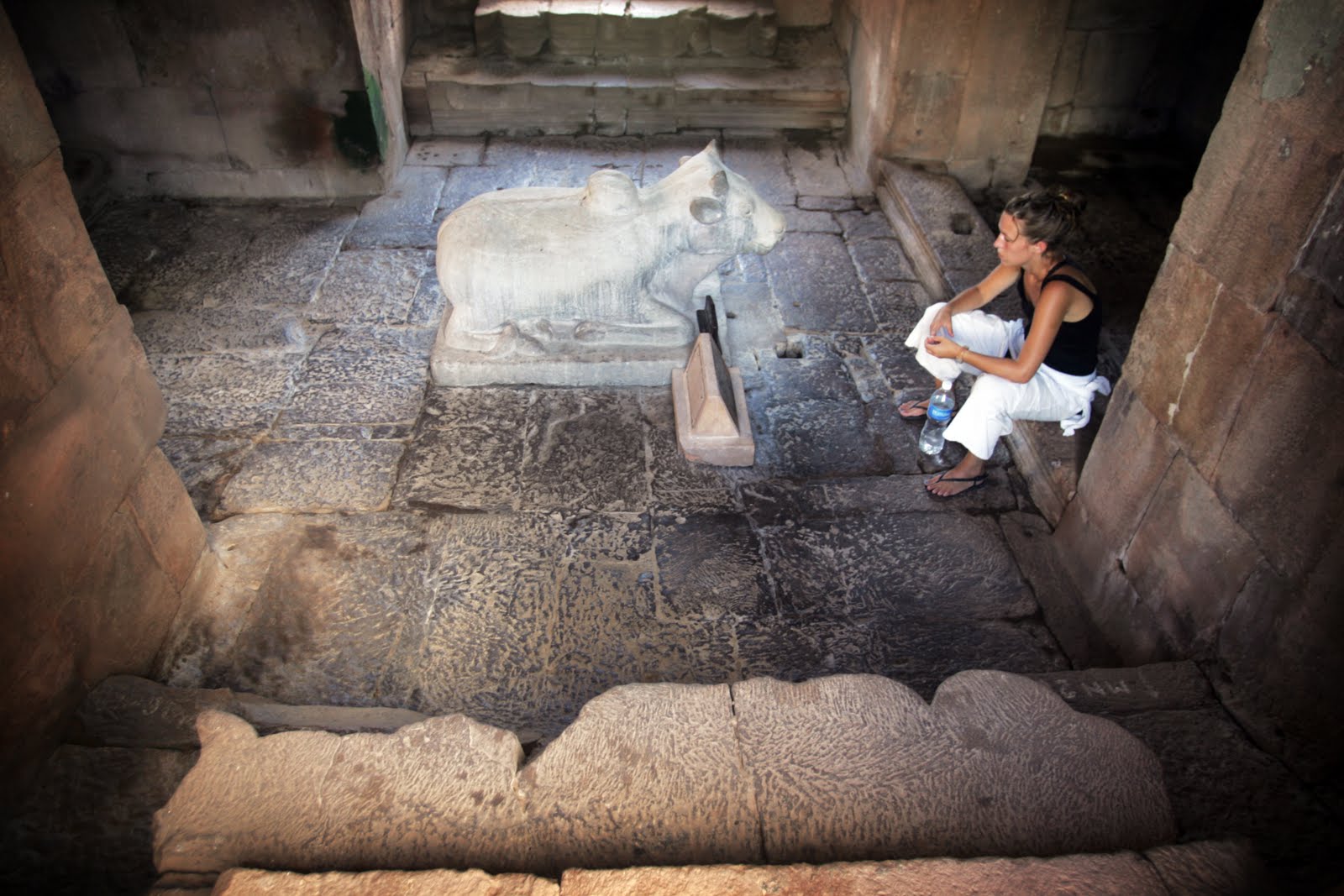
The ruins were well-restored, and the grounds nicely manicured. I always feel, though, that this takes a little away from the atmosphere and gives the ruins more of a museum feel. This was my first time seeing Hindu temples in Southeast Asia. I started to come to understand large swaths of Southeast Asia (especially the Khmer Empire of present day Cambodia) was Hindu, rather than Buddhist.


The ruins we were looking at contained elaborate carvings of scenes from Hindu mythology as well as sculptures of Shiva, Vishnu, and his carnations Rama and Krishna. Being from the same era and empire, it shared a lot of similarities to the famous temples at Angkor Wat.


We had the ruins to ourselves for a while, but when a couple of groups moved in (a French family and a group of loud, rich Thai men) we decided to proceed through the ruins and down the other side.


There were a few food stalls at the other entrance, but everything looked overpriced and uninteresting so we decided to hitchhike instead. We weren’t sure if we could hitchhike in either direction. According to my map we could take the road in either direction, but we decided to go and ask the man at the tourist information booth. We went into the small glass-walled building and there was a security officer sitting behind the desk, fast asleep. I figured he would wake up in a moment or two, but he didn’t. We tried talking louder as we looked through tourist pamphlets. We shuffled along the tile floor loudly. Eventually we made various loud noises, but it did nothing. I wasn’t about to tap this guy on the shoulder or yell at him, so we ended up just walking out of the place.


We took our chance leaving the opposite direction than where we had come from. The man that picked us up in the back of the pickup truck couldn’t tell us where he was going, due to language barriers, but he seemed to know where we were going and would drop us off. It always seems to be backs of pickup trucks in Thailand. Isn’t it glorious? Apparently Thailand has a higher number of pickup trucks per capita than any other country. Take that Texas!


We wound through the well-paved country road, past small villages and vast rice paddies. For a while, we weren’t sure if we were actually going in the right direction. We had twisted and turned so much that we had lost our bearings. Eventually, though, we emerged into a small town intersected by the narrow highway. He dropped us off near the bus station, but we found that there were no buses going to Surin. So as we walked through town, we waded through hoards of students as they got out of their primary, secondary and whatever other schools. Food stalls lined the streets, selling youth-friendly treats. We hadn’t eaten any lunch so we decided to try some after school snacks. One guy had a variety of Fantas and Coke in two-liter bottles that he would serve in cups with ice. One of the snacks was some sort of sweet flat bread, not unlike a pancake with a peanut filling. There were a few fried snacks and some things that were pretty obscure and beyond my memory.


Back on the road, we got a ride from some teenagers driving a covered pickup truck. They seemed to pull over without realizing that their truck bed was filled with something like school furniture. Desks, chairs, etc. They didn’t think we would be able to fit, but we eventually wedged ourselves into the mess.

In Surin that night, we did our normal routine of visiting the night market. For our third time, though, it was getting a little boring, and we wanted to sit and have a meal, rather than snacking from various food carts. So we went around the corner to the town’s other, more low key market. This one seems to be an all-hours market. Produce, meats, typical market things by day, and stalls serving noodles, rice, curry, roast meats, etc. by night. We found a spectacular local phad Thai stall (no, that stuff you get at carts on Khao San Road can barely be described as phad Thai) and ordered some cheap beers from an adjacent stall. As we were eating, a small elephant showed up, walking through the market with its trainer. It was remarkably cute because it was small enough to fit through the aisles of the market and wasn’t too tall for the roof.


Lise has a good friend from university who was partially raised in Cambodia. She was spending the summer at her parents’ house there, and had invited us to come for a visit. This was part of the reason that we had come to the part of Thailand that we did. It was not to far from the Cambodian border, so as soon as we were ready to get there, it would only take a couple days.


It was time, so we packed our bags and walked south out of town just like we had done the day before. We easily got a ride to the town of Prasat. Next we were just a quick 30 km jaunt to the border of Cambodia. An upper middle class family with a new king cab truck picked us up. We volunteered to sit in the bed, but they insisted we cram into the cab with them. I like to interact with the people that pick us up, but I also get self-conscious when people pick us up in a gleaming air-conditioned vehicle with leather seats. It was a friendly family, though we could not communicate with them. In some places it seems easy to equate skills in a second language (English, French, Spanish) to increased development or higher education. Relatively developed Thailand, however, having never been colonized, speaks much less English than, for example, the Philippines, which is far poorer. Kerala, one of India’s wealthier and better educated states will have far more English speakers than, say Bihar, India’s poorest state. In Thailand, which is one of the more educated and developed countries that I have traveled in, seems to speak far less English or French than perhaps any other country I have traveled in. It can be surprising since in places like India, I equate wealth with education and therefore with English skills. This is a misleading notion in Thailand.


When we reached the border, we parked the car and continued on foot toward the immigration office. I realized that this family didn’t have any actual business being inside Cambodia. We followed them toward the office. They handed a small wad of cash to the official sitting at the booth and the whole family proceeded through, unbothered. No passports, IDs, stamps or visas were involved. You see, gambling is illegal in Thailand, although it is not in Cambodia. Therefore at any border between the two countries, there are some upscale casinos directly across the border. There were loads of Thais pouring through the gates to get there gamble on, and maybe stay at one of the fancy hotels.

We passed through the Thai immigration office and received our stamps. Then we noticed that the Thais didn’t even need to enter Cambodia to go to the casinos. They were actually right there in the no-man’s land between the two borders. On the other side, it looked like there was nothing even on the Cambodia side of the border, except an empty dirt road.

Northeaster Thailand, huh? Well, seeya later.


August 17, 2011


On our way out of Bangkok in the evening, we took a local bus to the train station. The traffic was horrendous, but it didn’t matter since our train would leave late at night. We joined the other Thais that were waiting in the large open space without chairs. I unfolded my tarp, laid it out and we got a few hours rest before our train departed. The train ride was pleasant, but uneventful.


Surin, at first glance is a depressingly typical Thai town. In fact it seemed like it could have been anywhere in the world. Despite this, though, we knew immediately that we had flung ourselves far from Thailand’s large and well-beaten tourist path. Very few people spoke English and most signs were only in Thai. There were hotels, but not the typical kind that cater to backpackers or foreign tourists. It was a long, hot walk through town before we found our “Sangthong Hotel”. It was huge, and seemed nearly empty. The price was less than we would have paid in Bangkok and we had a much nicer room.

Our forage for a meal turned out to bere far more difficult than anticipated. Perhaps we had bad timing, but it seemed that very little was open and what was open didn’t have much to help out the non-Thai speaker. I realized that I had become spoiled. Since the previous two countries we had been in had been colonized by English-speaking countries, I was used to English being fairly common. Even in West Africa I was able to get by on French almost anywhere. Now we were in a mid-sized town in Thailand, of all places, having a surprisingly difficult time getting a plate of noodles. We eventually settled for a cold bowl of gelatinous noodle soup. It was one of the more boring Thai meals we ever had.


We made up for it in the evening, though, where we discovered Surin’s night market. It had a lively atmosphere and it was interesting to receive so much attention in a country that has so many foreign tourists. We sampled all sorts of small dishes from the different booths before further wandering the city. We went to another area that supposedly had some nightlife. There indeed were a few of bar/restaurants, but they were almost deserted. One of them had “live music”, which was bordering pretty closely on karaoke. A man sat behind a keyboard with a microphone and a laptop. He didn’t seem to do much with the keyboard, but would sing along with the karaoke music coming from the laptop. He was a good singer, but his setup was still a little funny. There was only one person there, and it turned out to be the server. We decided this would be a weird, but maybe fun place to sit with a beer. Since we were really the only customers, we were able to shout a few requests the singer. Eventually, though, he offered us a turn. Since we were already having karaoke withdrawals since leaving the Philippines, we were quick to hop on stage. I sang a Creedence song and Lise sang her specialty, “My Heart Will Go On”. Afterword, as we were sitting at the table close to the open front of the restaurant, an elephant came walking down the street, led by his caretaker. It was a funny sight, and Lise was especially excited. He was making his rounds around town, looking for people that wanted to pay a few Baht to feed the elephant. We handed over a couple coins for sugar cane and bananas. The elephant eagerly stuck out his trunk, greedily grabbing at the snack. We wanted to savor it though, and gave him the bananas and sugar cane sticks one at a time.


We weren’t sure of what our next move would be, but the next morning, we packed our bags and checked out of the hotel. We were planning to go to a village just north of us to see an obscure elephant farm. We had ideas of going on to another town further along, or perhaps camping at a nearby river. Either way, we walked out of town, past the train tracks, moving north along the widening boulevard that stretched out before us. It was hot, and the traffic was moving fast. Not the best hitching conditions, but we eventually made it to a traffic light near the edge of town.


It took less than ten minutes of waiting to get our first ride in the back of a pickup truck. The man drove us to a turnoff that would lead us to Ban Tha Klang, the village with the elephant farm. Our map must have been pretty inaccurate, since we had thought it would be a straight shot on the same road from Surin all the way to Ban Tha Klang. We quickly got a ride down the winding country road in the back of another pickup truck. A middle-aged woman sat in the back with us, with a big, almost devious smile. She tried to speak with us, but there was not much we could communicate to each other, except that we were going to the elephant farm.


We got dropped off right at the gate of the “Elephant Study Centre” in Ban Tha Klang. It was pretty obvious that we were in for a kitschy treat. We were a little bit early for the 2:00 elephant show. Tourists, mostly Thai, trickled in slowly and took seats on the wooden bleachers around the performance space. There were a few pudgy and pasty western tourists, and even that was a little surprising. There are so few major attractions in this region of Thailand that I was surprised that anyone would spend vacation time coming out here.


The elephant show began with a few of the beasts lumbering and shimmying to the rhythm of Thai music into the middle of the performance area. Then they moved into a series of tricks, each a little more impressive than the last. One of the elephants painted a picture with a trunk, while the next one threw darts at a balloon on a target. Between the acts, the trainers would bring the elephants to the audience and sell bananas and sugar cane to be fed to the animals. Then the elephants would dance some more and eventually they got into playing sports! Yes, it was cheesy and kind of awkward, since I wondered how the elephants were treated, but they did indeed make impressive showing in basketball and soccer. Not only could they slam dunk a basketball, they could make the occasional free throw. Not only could they kick a soccer ball with considerable force, a couple of the elephants could play goalie pretty well and make saves with their feet.


After the show, we perused the souvenir stalls. Lise was in the market for some Christmas gifts for her family, and she came up with a couple of decent finds. We also used this to bide our time while the tourists all left in the overpriced shared taxis. We figured we had made it here by hitchhiking, so we could probably get back as well.


As we were waiting by the road, we saw the same grinning woman that had been in the truck on the way there. She seemed to want to get our attention. It was rough communication, but it seemed that she wanted to hook us up with a ride. Her husband came and pointed to his nearby tractor, saying he could take us back to the main road. It didn’t appear that he was going there anyway, meaning we would probably have to pay. We started to sense some opportunism, and figured they were looking to make a little money (not that there’s anything wrong with that), so we declined and kept walking down the road. Soon a truck stopped for us, and we hopped in the back. We had said through the window that we had wanted to go to the main road. They didn’t understand, but they were going in the right direction, so we figured we would just get out when we got there or as far as they were going. After ten minutes, though, we could tell they were driving with less confidence. They had taken some weird turns and eventually had taken us in a circle. They asked for directions from a shopkeeper, and turned back the way we had come. It turned out that they had been in the wrong direction the whole time, so we ended up back at square one by the elephant farm.


A few minutes later, a decrepit old pickup passed by and picked us up. We hopped in the back with the other passenger, an old farming woman. She had red-stained teeth from chewing betel nut, a common practice among the elderly women around here.


When we came across a sangthaew (extended pickup truck with a roof over the back used for public transport) heading all the way to Surin, we were coaxed from one vehicle to the other. The inside was crowded, so I said we would ride on top. They were fine with me climbing up, but when Lise tried, the men in charge protested. For whatever reason, they found it unacceptable for women to ride on top of the truck. Lise insisted, causing a brief conflict, but she won out.


The sunset ride into Surin was relaxing and beautiful. We didn’t accomplish too much in the day, but with so many rides in the open air, we felt at ease and comfortable.


Thursday, December 22, 2011

Bangkok: Welcome Back


Our flight to Bangkok arrived just in time to catch the last train to the city. It took us about halfway to the neighborhood around Khao San Road, Bangkok’s notorious backpacker zone. On the train, we met a young French couple, who we assumed were going to the same area, based on their dreadlocks and filthy backpacks. We asked if they wanted to share a taxi. I was glad they said they would rather take the bus, since it showed what kind of travelers they were, but I knew that the buses had actually stopped running at this hour.

It turned out that we were also heading to the same guesthouse, since it is one of the cheapest around. I was surprised that when we arrived that I recognized it. It was the exact same guesthouse that I had stayed in when I first arrived to Thailand on my way to India five years prior. It felt strange to unexpectedly land back here again after such a long time.

We spent a few days lazing around Khao San Road. What can one say about one of the world’s largest backpacker hubs? Well, I can’t say much good about it. It is a bizarre oasis of almost Thai-free culture that gave me the biggest culture shock of my life five years before when I landed there after three months in India. I didn’t consider liking it or hating it the first time I passed through there before India, but on the way back it was utterly dreadful. I was shocked at what tourism had destroyed in a city. I was appalled at the disgusting consumerism and hedonism that prevailed in every corner. Every tourist seemed to have a complete disregard for the fact that there was an incredible city with fascinating culture to explore a few blocks away. This time, however, I knew what to expect, and I was ready to treat it for what it was: a cultural anomaly that had developed some time in the last quarter, maybe half, century. I didn’t have to approve or disapprove of it. With the right approach, I could treat it like any other culture that I come into as an outsider. I don’t have to agree what goes on, but it is interesting to watch nonetheless. I may not approve of the caste system in India, women’s veils in Muslim countries, consumerism in Malaysian malls or anything going on in Vegas, but since I have little to do with these cultures, I can sit back and watch the show.

So we explored the trinket stalls, ate crappy phad thai and banana pancakes, drank beer in the streets, but mostly we just sat and watched it all go by. We hadn’t seen many travelers in our month and a half of travel, and this was a veritable parade of backpackers and tourists ranging from the filthy hippy with meter long dreads, to the frat boy fresh from the beach with a maraschino cherry sunburn, and everyone in between. We were both surprisingly content with just sitting around and watching the diverse hordes of foreigners from all over the world make their way through these crowded streets.

As packed as it was with foreigners, it was interesting how we could randomly stumble upon some local Thai treasures that seemed completely overlooked. Just a couple doors down from our guesthouse there was a row of a quaint bar/cafes, all with local musicians performing. One had jazz, another folk and another had some Thai rock. For some reason, all the foreigners were passing by this bit of easily accessible culture. Although the beer was a bit pricier than we were used to, we decided it would be worth it to listen to some of the music. It was hard to believe that we could be so close to Khao San Road and be the only foreigners at a bar with live music.

We bided our time in the city, deciding on our next move. In the mean time, we did some modest exploration. Bangkok is a lively city with plenty to see and do. Unfortunately, a lot of the most impressive sites cost quite a bit, so we decided we would put those on our list of things to do on another trip to Bangkok when we had more money. It was now my fourth time in the city, although every time seems to just be a couple of nights and I still haven’t seen much of it. One of our little excursions took us onto one of Bangkok’s many canals that streak through the city. It was nice to see that they are still quite popular as a means of transport. The canal stank, and we were fortunate that they pulled up tarps to protect us from the splashing as we hit top speed in our long boat.


Beyond some random wandering though, most of our time in Bangkok was spent regrouping. Lise and I had both been sick just before coming here, and we were still weak. We had some practical errands to run (post office, book store, internet, etc.) as well as the obligation to figure out where we would go next. We had decided to meet a friend of Lise’s in Cambodia, so we planned our trip around that. We didn’t have much desire to hit the famous islands of the south, and didn’t have much desire to go to Chiang Mai, Thailand’s other major hub of tourism. We decided to go to Surin in the northeast, a region that is close to Cambodia and relatively tourist free.

Tuesday, December 20, 2011

Leaving the Philippines

August 16, 2011


Lewis, our couch surfing host, had to go to his first day of work. He left early and gave us the key. Now that I had finally tried balut, seen a cockfight and sang lots of karaoke, I felt like we could leave the Philippines. We would be leaving in the afternoon to go to the airport. Unfortunately, though, Lise was feeling as bad as the day before. She had a high fever and intense muscle aches. There wasn’t much she could do but take the paracetemol and get rest. We were so fortunate to have Lewis’s hospitality. It was a complicated situation because we had to arrange a hiding spot for his key. We would leave before he returned from work, but he welcomed us to hang out in his place all day. This was a godsend for Lise. She spent most of the day sleeping, while I hung around the apartment, also relaxing. Unfortunately because we had both gotten sick, we had not gotten to experience much of Manila. I had been excited to see the chaos of this notorious metropolis, but it wasn’t meant to be.


Luckily when was time for us to leave, Lise was feeling a little better, but not great. Getting to the airport would be a major transport adventure. To save money, we were flying from Angeles, an hour north of Manila. To save more money, we would be taking a jeepney, a light rail a bus and a tricycle to get there. I estimated that we could make it there in three hours, which, in reality was optimistic, as we would be doing it around rush hour.


Finding the correct jeepney to get to the light rail was a bit tricky, especially with our enormous backpacks. It took us a lot of walking and asking around, but we eventually found it. It took us to a short walk from the light rail. We were already behind schedule, so the huge crowds around the light rail were frustrating. We climbed a couple flights of stairs and found a huge line to get through security. When we finally got to the front, they took a surprisingly long time going through my backpack, having me take out a lot of stuff, only to repack it all afterward. When we got to the ticket booth, we found that we had come to the wrong side of the station. We had to fight back through the crowds, go down the two flights of stairs, cross the huge boulevard with a concrete barrier in the middle, and climb the two flights of stairs again. Then there was security again. They searched our bags thoroughly before lettings us through.


The crowded light rail was sweaty, and hauling our bags wasn’t making it any easier. When we arrived at our stop, we found ourselves in an overwhelming mess of wide, crowded streets, pedestrian mobs, and a maze of catwalk-like pedestrian overpasses. Somehow we asked directions to the bus station from a woman who was going on the same bus that we wanted, so she invited us to follow her. We walked up stairst onto suspended walking platforms that crossed large intersections and continued above sidewalks. We seemed to twist, turn, ascend and descend so many times that there was no way we could have done this without her. As soon as we reached the station, we saw our bus getting ready to leave. There were three spots left, so we hopped on and continued on our way. Now we could breathe easy.


I was not so excited to pass through Angeles. It is the prostitution capital of the Philippines, with an estimated 10,000 sex workers. It is estimated that before the American military left the country there were about 100,000 women employed in the city. Needless to say, I did not want to linger here. We tried to get a tricycle to take us to the airport, but the drivers near the station were demanding too many pesos. After a walk around some of the streets, we discovered we could take a jeepney to the airport for far cheaper.


At the tiny terminal, we found our check-in counter (the only one open) and stood in line. I had tried the day before to change my baggage allowance online. When I bought the ticket, I had purchased 15 kg worth of bag. I had realized that I would definitely need more. Unfortunately, it seemed difficult or maybe impossible to adjust this on the website. When my bag was weighed, it came out to 23 kg (50 lbs.). I was told that would be an additional $75. I explained that I had tried to change it online, and she said that changing online was impossible (obviously so you would get grossly overcharged at the counter). Lise took over, arguing assertively that this did not make any sense, and I should only have to pay the difference that I would have paid online (about $7). Perhaps it was from the leftover stress from our journey to the airport, but Lise got impressively angry, leaving the attendant unsure of what to do. So we took the opportunity to start unloading my bag, and moving my heaviest items into Lise’s bag and my carryon. The attendant saw that this was going to be a bigger hassle than she wanted to deal with and the line behind us was growing. She gave in and said to repack my bag and send it through, warning me that next time I needed to remember to buy my bag online next time.


Next we had to pay an unexpected “airport fee” of 750 pesos (close to $20). We had already gotten rid of most of our pesos and there was no ATM at the airport, so we tried our luck making a big angry scene at this booth as well, since we had never heard of this (and usually this fee is included in the ticket prices). The man in charge of collecting the money would not budge. He never got rude (although we may have crossed the line), he just apologized and smiled, saying we could change US dollars nearby. We claimed not to have any dollars, but he still wouldn’t give us a break. We were forced to go find the money changer. The rate was not good, nor was it negotiable. I changed enough for both of us to get through. Somehow I had accumulated handfuls of peso coins, and used this opportunity of bitterness to unload all of them with the man at the “airport fee” booth. As he counted the pile of coins, he seemed to actually think it was kind of funny.


The waiting area was predictably appalling. As we were going between two of the world’s major sex industries, Manila and Bangkok, we were surrounded by some of the world’s sleaziest. Lise was the only (seriously, the only) white female taking this flight. About two thirds of the people were white men (most middle-aged or older and overweight) while the other third were young (at least half the age of most of the men) Asian women on the arm of one of the men. Some men were traveling with multiple women. Most of the foreigners we had seen in the Philippines were of this sort, but seeing them in such volume in an enclosed space was truly depressing. At one point I saw what was most certainly a father-son sex tourism vacation. The father in his fifties had a girl in her twenties, while the son, in his twenties had a girl that I hope was in her twenties. I ignorantly wondered why so many of the men shaved their heads, while Lise pointed out that it was to seem younger. They all were yearning for a time when they were younger and being free and wild was more accepted. Most of them had tattoos and a large gut, a symbol of their hedonistic consumption. Everyone acted like it was all normal, while Lise and I felt awkward. As much as we had avoided traditional backpacker hangouts, we actually looked forward to getting to Bangkok, where tourists of all varieties flock, and the sex tourism, while still huge, tends dissolves into the mix.

Wednesday, December 7, 2011

A Manila Hospital Tour

Makati Medical Center, I believe, is the Philippines’ finest medical facility. I was caught off guard, as my introduction to a notoriously chaotic city was a hospital that on the surface appeared to possess as many western luxuries as you would get in an airport. There was wi-fi, Burger King, filtered water in the taps, comfortable waiting rooms and even a Seattle’s Best Coffee. It was nearly the first time we saw westerners that weren’t sex tourists.

We made our way to the lab, where I would get tested for malaria and Dengue fever. Maybe the proper procedure should have been to go to a doctor first and follow his instructions, but I was almost certain it was malaria, and if it wasn’t then I probably didn’t have much to worry about. When my number was called, I explained that I wanted to get a malaria test and a Dengue test. When they told me that for the two tests, it would cost me about $80, I reconsidered the Dengue test. I decided I would start with the $20 malaria test, and go from there. By the way, a malaria test at a hospital in Mali cost about $3, so I felt like I was getting a little ripped off for the five minute procedure.

After the nurse drew my blood, I asked her how long the results would take. She said that it took eight hours, and since they close at 5 PM, I would have to come back the next day. When I brought the news of the long wait to Lise, she was outraged. After all, it is malaria, not a head cold. She went. She went to the counter, bypassing the whole number system, and demanded to know why it would take so long to process my test results. (In Mali the results took about 30 minutes to an hour). She was told that I could get it processed in two hours if we paid an extra 50%. This seemed like a completely ludicrous way of conducting the business of medicine, but we didn’t have much choice. We anted up, and sat in for the wait.

I was still feeling somewhat feverish when I got my results. I was a little disappointed to find that I did not test positive for malaria, since now I didn’t know what was wrong with me and there was still a possibility of Dengue, which is no picnic either. I couldn’t afford the expensive test her, so we figured out where the public hospital was and got a taxi. It felt awkward to be taking taxis when I knew we could probably figure our way around with the public transit system, but Lise insisted this wasn’t the time to be penny-pinching.

Before we even reached the ER at Manila’s largest public hospital, we could feel the chaos. Family’s were rushing in or hobbling out around us as we approached. Outside the doors of the ER, dozens of people were sitting around at various stages of treatment. Some had bandaged wounds, while others were still waiting to be attended to. Sickness hung in the air. As crowded and overwhelming as it was, we were given attention almost immediately. As a young doctor came to ask me some questions, a body wrapped in gauze was carried out the front door next to us. A young nurse joined in and I was answering rapid-fire questions from two directions. They were collecting information about my symptoms while another person came to take the details about my name, address, etc. Somebody also seemed to be gathering information from Lise. I was kind of in a daze, trying to figure out which parts of my body were in the most pain, and whether I had experienced any congestion in my sinuses. Somebody came with a device to check my blood pressure, but did not use it for this purpose. They wrapped it around my arm extra tight, pumped it up as high as it would go and left it there for about five minutes. This is a quick and dirty way of checking for Dengue, I would find out. After taking off the device and examining my skin for small bumps, they determined that I probably didn’t have Dengue. In the end, there were probably four people, all medical students, working with us. The whole thing took about ten minutes. They told us that because my condition was too serious and they were (as always) so overwhelmed with patients that we would have to go to a different hospital. I didn’t mind this at all. This hospital was inundated ­with the poor masses that couldn’t afford better treatment. As much as I was on a budget, I knew that if I had stayed there I would have been taking the spot of someone in much more need than me.

So now, still hauling around ever-growing backpacks, we asked around for directions to another hospital. After a twenty minute walk, we arrived in the afternoon heat to a hospital that was somewhere between the opulence of the first hospital and the squalor of the public hospital. After speaking with a couple different nurses and doctors, they seemed unsure of what might be my problem. They insisted that I get a few tests done, including the Dengue test. They sampled my blood and urine, and then it was a matter of waiting for an hour. Although this hospital was not nearly as modern as the first one, it was far more personal and I felt the care seemed adequate.

I was actually kind of nervous when the nurse came to give me my diagnosis. I had expected the tests to be inconclusive, but they weren’t. I did not have dengue, but I did have a urinary tract infection. That was unexpected, as I didn’t know that would give me days of fever and muscle aches. They agreed it was odd too, since I hadn’t experienced any of the typical symptoms of this. Apparently it can be common for westerners when they come to hot and humid climates, especially if they are chronically dehydrated. They prescribed me some antibiotics, I paid my bill ($77? Not too bad) and sent me on my way.

Now we were on the hunt for a hotel room. We were close enough to the neighborhood with most of the cheap hotels to walk there. We ended up settling for a sleazy place with thin walls and dirty shared bathrooms at an unimpressive price. The neighborhood, being a major area for tourists, was less modest than what we were used to with a healthy red light feel. Our hotel was on the third floor of a building, and walking up the stairs we passed a girly bar advertising with skanky portraits of their lineup of dancers. Outside, there were swanky malls, western restaurants, a variety of bars, alongside tacky, neon-laden strip joints, thinly veiled brothels and over-sized karaoke clubs.

In the evening, we wandered around in search of the Philippines that we had grown to enjoy after dark, but it was nowhere to be found. The karaoke bars were big and showy, where customers would rent a private karaoke room and buy expensive cocktails. Basic eateries, food stalls and a humble, locally made videoke machine were nowhere to be found. We walked through the neon jungle for an hour, considering a splurge on Korean BBQ or Middle Eastern food. Everything was just too expensive, though. We finally found a guy with a food cart attached to a motorcycle. We bought some cheap noodles from him and headed in from our lackluster night in our lustrous neighborhood. On the way back, scantily clads from the strip joints called out to us from the entrances, trying to get us to come inside, while the occasional lady boy made passes at us.

The next morning, Lise was feeling in bad shape. She had a fever and muscle aches. So we packed our bags, checked out, and walked back to the hospital. Now that we had been to three of Manila’s hospitals, we knew the routine. After spending most of the day at the hospital, and going through various tests, it turned out that she didn’t have anything. The doctor couldn’t really explain what was giving her the symptoms, so he just gave her some paracetemol and told her to get some rest.

That evening we met up with Lewis, our couch surfing host from England. He was spending a few months in Manila for an internship with Unilever. He lived in a neighborhood much more of our taste than where we had stayed the night before. Plus, his three-bedroom apartment was far more comfortable than most any hotel room we had stayed in on the trip.

One of my major impressions of many British people, even the traveler types, is that they are exceptionally proper. Lewis was no exception. He dressed well, kept his shoes shined and his apartment tidy. Although we knew we were dirty, he still made us feel welcome. More importantly though was that beneath our contrasting appearances, we all had a similar thirst for adventures and rugged traveling.

He was brand new in the city as well, so when he was showing us around his neighborhood, he was still getting to know it. He showed us a place where he had enjoyed dinner the night before. It was a humble, hole in the wall eatery with a few plastic tables and chairs in front. They specialized in “silog”, the dish of rice, fried egg and some variety of meat. We chose our respective “silog”. I chose the classic, tapsilog. I had had this a couple times before, and was usually under whelmed. This time, though, something was different, and I was excited about Filipino food once again. The biggest difference was in the quality and rich flavor of the meat. Something about the simplicity of the rice and egg alongside it was enjoyable as well.

We wandered through various streets on the way back, getting a feel for the neighborhood that, for a big city, felt like a small village-like community. Many people were out in the streets, enjoying life and being friendly with each other. Just as we decided to find a beer to take back to the apartment, the rain came without warning. It poured so strongly that it didn’t make much sense to try to stay protected by storefront awnings. Five seconds of exposure would have you soaked to the bone.

After getting the beer, we passed a balut vendor. Now, balut has become quite famous as one of the world’s most…unique foods. For those that don’t know, it is a hard-boiled fertilized egg with a partially developed chicken fetus inside. Over the years I have built a decent resume of strange foods consumed. Bugs, bush meats, offal, unexpectedly fermented items, etc. This was a new step, though. For weeks I had been avoiding one of the biggest items on my to-do list in the Philippines. Knowing that there might be tiny bones or feathers in that little egg would be bad, but the juice that needed to be slurped out of the egg first truly terrified me. Worse yet, Lise said she would not join me on this culinary quest. I asked Lewis if he had ever tried balut. He casually said that he had the last time he was in the Philippines a year prior, and it wasn’t so bad. He was very casual about it and said he would try it again. I asked him about the juice that floats at the top. He said to think of it as chicken soup broth. Lise continued along as we walked up to the balut vendor. She didn’t want to see or hear it. A Filipino man had also arrived to have a snack, so we followed his lead. We punctured the top of the shell, and squeezed in a bit of the sauce that it came with. We knocked the egg back and sucked out the hot juice from the hole. He had been right. The juice was like a rich chicken broth. That was the easy part. Now we had to peel the rest of the shell off to reveal the horrific insides. I tried not to look (or think about) that recognizable shape of a baby chicken as I bit into it. There wasn’t much of a crunch, but it definitely did not have the uniform consistency of a hard-boiled egg. We chowed it down to the bottom, which was an inedible lump of cartilage. In the end, the flavor, to me, did not seem too far off than a regular boiled egg. It wasn’t bad at all, but the different texture would be something to get used to.